Tips for First-Time Flyers

The four tips for first time flyers that matter most: arrive 2 hours early for a domestic flight and 3 hours for an international one, bring a government-issued photo ID that matches the name on your ticket (see what to do when the name on your ticket does not match your ID), keep every liquid in your carry-on under 3.4 ounces in one quart-size bag, and check in online the day before so you already have a boarding pass on your phone.
Everything else at an airport is signage and lines. If you do those four things, the day works. Nobody is going to single you out for being new, and staff answer questions all day long.
Not sure about something in your bag? Check it in our free Can I Bring It? tool before you leave the house. It covers the awkward ones: aerosols, batteries, food, scissors, medication, and the things that are fine in one bag but not the other.
Updated September 2026. Screening rules change and vary by airport. The TSA's What Can I Bring? page is the authority on items, and the Department of Homeland Security REAL ID page is the authority on which IDs are accepted at the checkpoint. A TSA officer always has the final say at the lane.
The Day, in Order
Here is the whole thing on one timeline, so it stops feeling like a mystery.
| When | What happens | What you do | What you are holding |
|---|---|---|---|
| 24 hours before | Online check-in opens | Check in, pick or confirm a seat, save the boarding pass to your phone | Phone |
| Night before | Bag packed | Liquids bagged, chargers packed, ID and card in one pocket | Everything |
| 2 hours before (domestic) | You arrive | Bag drop if you have a checked bag, otherwise go straight to security | Bag, ID, boarding pass |
| 90 minutes before | Security | ID and boarding pass out, bag on the belt | ID, boarding pass, liquids bag |
| 60 minutes before | Airside | Find the gate first, then eat, then browse | Just your bags |
| 40 minutes before | Gate area | Fill the water bottle, use the restroom | Boarding pass ready |
| 30 to 40 minutes before | Boarding starts | Listen for your group number | Boarding pass, sometimes ID |
| 15 minutes before | Doors close soon | Be on the plane. Gates close before departure time. | Seat belt on |
The individual steps are shorter than the buffer suggests. Bag drop runs 5 to 30 minutes depending on the line, security anywhere from 10 to 45, the walk to a gate 5 to 20 in a big terminal, and boarding 20 to 30 from the first group call to the door. The buffer exists because those ranges do not line up neatly on the day you actually fly.
That gate-closing line is the one that catches people. The time on your ticket is when the plane pushes back, not when you can still be walking up. Most airlines close the door 10 to 15 minutes before departure and will give your seat away.
For a longer version of the arrival question, including holiday travel and big hub airports, see how early to arrive at the airport.
The Best Tips for First Time Flyers, in Order of Use
Check in online. It saves the longest line in the terminal. If you have no bag to check, you can walk from the front door straight to security.
Bring the right ID. Domestic flights in the US need a REAL ID-compliant driver's license, a passport, or another accepted federal ID. A regular state license without the star may no longer be enough, so look at your card now rather than at the counter.
Name match matters. The name on your ticket has to match your ID. If you booked with a nickname or a maiden name, call the airline before travel day. This is fixable early and expensive to fix late.
Wear the annoying stuff. Boots, the heavy coat, the bulky hoodie. They cost you nothing on your body and eat half a carry-on in the bag.
Pack the important things in your carry-on. Medication, documents, chargers, one change of clothes, anything valuable. Checked bags mostly arrive, but the ones that do not always contain something the owner needed.
Empty your water bottle before security, then fill it after. Nearly every US airport has a bottle filler past the checkpoint.
Find your gate before you do anything else. Gates change. Knowing where yours is turns a gate change from a panic into a walk.
Curb to Gate: What Actually Happens
The tips above tell you what to do. This section tells you what the day looks like from the inside, which is the part nobody describes and the part that makes it feel unfamiliar.
The night before
Ninety percent of a smooth airport day is decided at home, in about twenty minutes.
- Check in online. It opens 24 hours before most flights. Save the boarding pass to your phone's wallet, then screenshot it as a backup for the moment the airport wifi gives up.
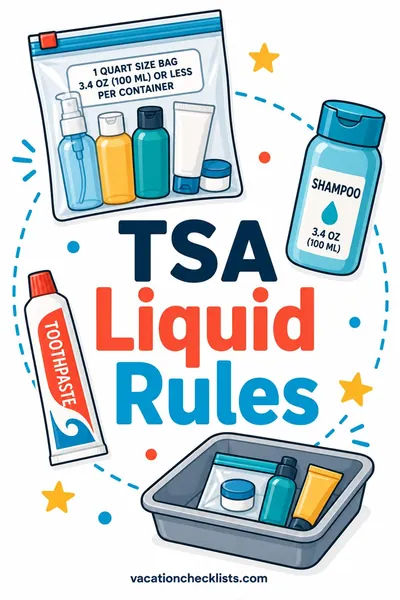
- Pack liquids last, into one clear quart-size bag. Every gel, cream, paste, aerosol and liquid goes in there at 3.4 ounces or less each.
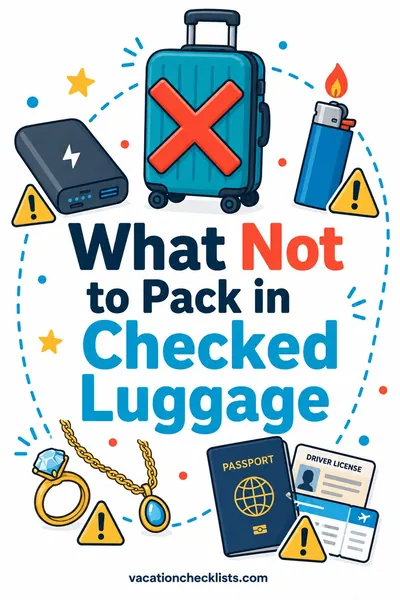
- Put chargers, power bank, laptop and medication in the bag you are carrying on. Spare lithium batteries are not permitted in checked bags at all, so that one is a rule rather than a preference.
- Weigh and measure the bag. A luggage scale takes twenty seconds and heads off the worst kind of surprise at the desk.
- Set out ID, card, phone and boarding pass. One pocket, and it is the pocket that never holds anything else all day.
Run the whole thing against our pre-flight checklist the evening before rather than the morning of, so there is still time to fix whatever it catches.
At the curb
You will be dropped at "Departures," which is usually the upper roadway. Whoever drives you cannot park there. Say goodbye, take the bag, go inside.
Then look up. Large signs list airlines by name and point at a row of desks, and screens list flights by number and destination with a gate and a status. Find your flight number, confirm it says on time, then find your airline's desks.
Nobody expects you to know where to go. Airline staff stand near the front of the check-in hall specifically to point people at the right line, and asking costs you ten seconds.
Check-in and bag drop
If you have no checked bag and you already have a boarding pass, you skip this entirely and walk to security. That is the fastest version of the day, and it is a large part of why people fly carry-on only.
If you do have a bag to check:
- Use the self-service kiosk if there is one. It scans your booking and prints a boarding pass and a sticky bag tag.
- Loop the tag through the bag handle so the barcode stays readable, then join the bag drop line.
- The agent scans it, asks a security question or two, and puts it on the belt. That is the last you see of it until the carousel at the other end.
- Keep the stub they hand you, or the receipt on your phone. If the bag goes astray, that number is what finds it.
The questions are a script, not an interrogation: did you pack the bag yourself, has it been out of your sight, are you carrying anything on the restricted list. Answer honestly and briefly. Allowances and charges vary a lot by airline and fare type, and our explainer on checked bag fees covers where people get caught out.
How Security Actually Works
This is the part that makes new flyers nervous, and it is genuinely simple once you have seen it once.
- Have your ID and boarding pass in your hand. An officer checks both at the podium.
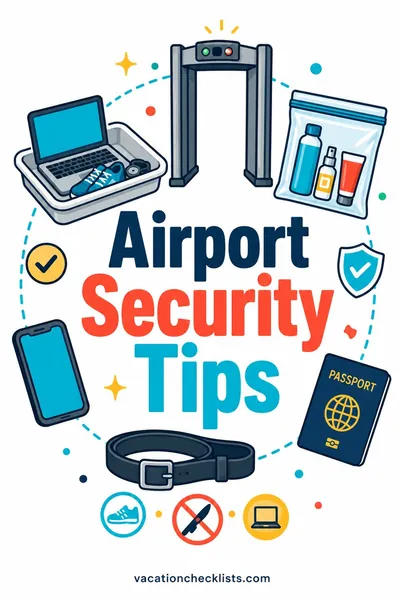
- Bins. Your carry-on goes flat on the belt with your personal item beside it, and the jacket goes in a bin. Empty your pockets into your bag rather than loose into the bin: keys, coins, phone, wallet, receipts. Loose items in bins are the single most common way people lose things at an airport.
- Electronics. Laptops and large tablets usually come out of the bag and go in a bin by themselves. Newer scanners at some checkpoints do not require this, and the officer will tell you.
- Liquids. Your quart bag of liquids comes out too, unless the lane has the newer imaging equipment.
- Shoes and belt. Standard screening means shoes off and belt off for most adults. Rules differ for children and older travelers.
- You walk through the scanner when the officer signals. Feet on the marks, arms up, hold still for about three seconds. That is it.
- Collect everything. Check the bin twice, and count your items off in your head: phone, wallet, laptop, jacket, both bags. Phones and passports are the two things people leave behind most.
The 3-1-1 rule is worth memorizing: containers of 3.4 ounces (100 ml) or less, all fitting in 1 quart-size clear zip bag, 1 bag per passenger. It is the container size that counts, not how full the bottle is, so a half-empty large shampoo bottle still gets pulled. Our TSA liquid rules guide covers the exceptions for medication, baby formula and duty-free.
If you are randomly selected for an extra swab or a pat-down, nothing has gone wrong. It happens constantly and it takes a minute. The same is true when a bag gets pulled off the belt: an officer opens it, swabs something, and hands it back. The usual culprits are a water bottle with liquid still in it, a jar of peanut butter, a snow globe or a stray battery, rather than anything sinister. Our airport security tips page has the full list of things that slow lanes down.
One more thing in your control: a zip hoodie, slip-on shoes and no belt turns the whole checkpoint into a ninety second event.
Airside: The Part Nobody Describes
Past the checkpoint you are "airside," and this is where an airport turns pleasant. Shops, restaurants, restrooms, water fountains, seats and, at last, nothing left to worry about. Do it in this order.
- Find your gate first. Walk to it and look at it. Now you know how far it is and how long the walk takes, which is the whole point.
- Then eat. You have the time, and airline snacks are not a meal.
- Fill your water bottle. Empty bottles pass screening without trouble, and refill stations are usually near the restrooms.
- Charge your phone. Your boarding pass lives on it.
- Sit where you can hear announcements and see a screen. Gates change. It is normal, and it is announced.
Give yourself 40 minutes at the gate. It sounds like dead time, and it is exactly the buffer that turns a gate change to the far end of the terminal, or a restroom line, from a crisis into a shrug.
Carry-On, Personal Item, Checked Bag
Three different bags, three different rules, and mixing them up is the single most common first-flight mistake.
| Bag type | Where it goes | Typical US limit |
|---|---|---|
| Personal item | Under the seat in front of you | Often around 18 x 14 x 8 in, but airlines vary a lot |
| Carry-on | Overhead bin | 22 x 14 x 9 in on most large US carriers, including handles and wheels |
| Checked bag | Cargo hold | Usually 62 linear inches (length + width + height) |
Two things to know. First, "including handles and wheels" is not a formality. Airlines measure the bag as it exists, not the marketing dimensions on the tag. Second, basic economy fares on several US airlines include only the personal item, so a carry-on you assumed was free can become a problem at the gate. Read what your specific fare includes on the airline's own page.
Measure before you go with our carry-on size checker, which holds the published limits for dozens of airlines, and use the personal item size guide if you are flying with just the one bag. Our carry-on packing list covers what to put in it.
Boarding, Seats, and the Plane Itself
Boarding happens in groups, printed on your boarding pass near the seat number. When your group is called, you scan the pass and walk down the jet bridge, which is the enclosed ramp from the gate to the aircraft door. It can be warm and it sometimes sways a little. That is normal.
There is no advantage to standing in the aisle for twenty minutes before your group is called, and there are real disadvantages if you are blocking people. There is one exception: if your carry-on is at the size limit, board with your group rather than late, because bins fill from the front of the plane back.
The announcements sound like code the first time. They are not.
| You hear | It means | What you do |
|---|---|---|
| "Pre-boarding" | Passengers needing extra time, and often families with small children | Stay seated unless that is you |
| "Group 1" or "Priority" | First class, elite status, some credit card holders | Stay seated |
| Your group number | Your turn | Get in line with your pass and ID out |
| "Final call" | They are about to close the door | Move, quickly |
| "Gate checking bags" | Overhead space is running out | You can hand your carry-on over at the door and collect it on the jet bridge when you land |
Seat choice, in plain terms:
- Window. A wall to lean on, control of the shade, nobody climbing over you. You have to ask to get out.
- Aisle. Freedom to move, a bit more legroom for one leg, and people brushing past you all flight.
- Middle. Both armrests are traditionally yours. That is the only upside.
- Front of the plane. Off first, useful for tight connections.
- Over the wing. The smoothest ride if turbulence worries you.
- Back row. Often does not recline, and it is next to the lavatories.
What Every Noise Means
Seat numbers run along the overhead panel, with letters across and numbers going back. Put your bag wheels-first into the bin above your row, sit down and get out of the aisle. Sorting out your book, headphones and snacks can happen once you are seated.
Then the flight runs through the same sequence every time, and every sound in it has a boring explanation.
- Safety demonstration. Watch it anyway, and note where your nearest exit is, including the one behind you.
- Pushback. A tug shoves the aircraft backwards away from the gate. You will feel it.
- Taxi. Slow rolling, sometimes for a long while at a large airport. Bumps and clunks on the taxiway are normal.
- Takeoff roll. The engines get loud and you get pushed back into your seat for about thirty seconds.
- Climb. Ears pop. The landing gear retracts with a solid thump roughly twenty seconds after the wheels leave the ground.
- Cruise. The seat belt sign goes off. This is where turbulence usually shows up, and it feels like a truck on a gravel road.
- Descent. Ears again. The flaps extend with a whirring noise, and the gear comes down with a much louder thump than it went up.
- Landing. A firm bump is a good landing, not a bad one. Then the engines roar in reverse for a few seconds to slow the aircraft down. That noise catches everybody the first time.
Ears. The pressure change on descent is the thing most new flyers actually feel. Swallow, yawn, chew gum or sip water as the plane comes down. If you have a head cold, a decongestant taken before descent helps a lot. Babies should be feeding or sucking on something during descent for the same reason.
Turbulence. It feels dramatic and it is a normal condition of moving air, like a boat on chop. Aircraft are built and tested to handle far more than a passenger will ever feel, and crews treat it as a comfort problem rather than a safety one. Keep your seat belt loosely fastened whenever you are seated, which is what crews ask for anyway, and it becomes a non-event. If you get carsick, take a seat over the wing and deal with it before departure rather than after: our guide to avoiding motion sickness covers what actually helps and when to take it.
Electronics. Phones go into airplane mode for the flight. Most aircraft allow phones and tablets throughout, with larger laptops stowed for takeoff and landing.
What to Pack in the Seat-Back Bag
Whatever you want during the flight has to come out of your bag before it goes in the bin, because standing up mid-flight to dig through the overhead is a whole production.
- Phone and a battery pack
- Wired headphones (many seat-back screens still use the old jack)
- Refillable water bottle, filled after security
- Snacks, since short domestic flights may only have a drink service
- A layer, because cabins run cold
- Lip balm and moisturizer in travel sizes, since cabin air is very dry
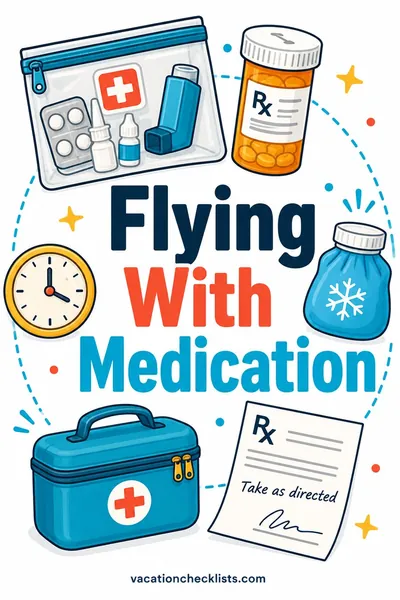
- Anything you take on a schedule, in its original packaging
- A pen for landing cards on international flights
For flights over about five hours, our long flight essentials list adds the comfort items that genuinely earn their space, and how to beat jet lag is worth reading before a trip that crosses several time zones.
Worked Example: A 9:40am Domestic Flight
Suppose you have a 9:40am departure from a mid-size US airport, one carry-on, no checked bag, and no PreCheck.
| Time | Action |
|---|---|
| 9:40am the day before | Check in online, save the boarding pass, screenshot it |
| 6:45am | Leave the house, ID and card in a pocket you can reach |
| 7:40am | Arrive at the terminal, walk straight to security |
| 7:55am | Through the podium, bins loaded, scanner |
| 8:10am | Airside. Walk to gate, confirm it matches the boarding pass |
| 8:20am | Fill the water bottle, get food, use the restroom |
| 9:00am | Back at the gate, seat-back items pulled out of the bag |
| 9:10am | Boarding begins by group |
| 9:25am | You are seated, bag in the bin above your row |
| 9:40am | Push back |
Two hours sounds excessive until security has a line, and then it is exactly right. The worst case if the airport is quiet is that you have a spare 45 minutes in a chair with your phone. Missing the flight costs a great deal more than that, as our guide on what to do if you miss a flight explains.
If You Fly More Than Twice a Year
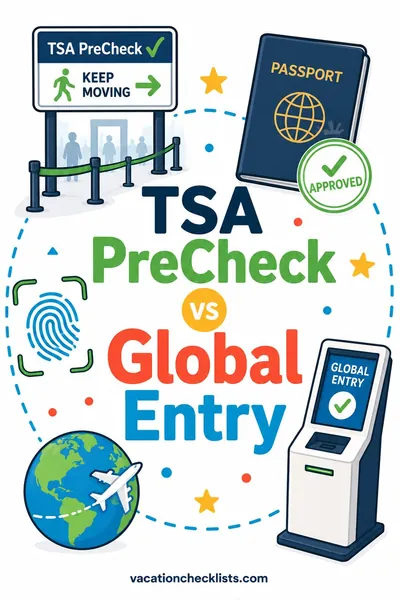
Two programs are worth understanding once you have a flight or two behind you. TSA PreCheck keeps your shoes, belt and laptop where they are and uses a shorter lane. Global Entry includes PreCheck and also speeds up your return through US customs from abroad. Both require an application and an in-person appointment, and both charge an enrollment fee that is published on the official government sites.
Our comparison of TSA PreCheck vs Global Entry covers which one fits which traveler, and what is TSA PreCheck explains how the lane actually differs.
Common First-Flight Worries, Answered Briefly
"What if I get lost in the airport?" Follow the overhead signs and ask anyone in a uniform. Airports are built for people who have never been in them.
"What if my bag is too big?" Gate agents will check it planeside. It is a mild hassle, not a catastrophe.
"What if I have to use the restroom during boarding?" Go before you board. Aircraft lavatories are typically unavailable while people are still filing on.
"What if I am scared of flying?" Tell a flight attendant when you board. They deal with nervous flyers constantly and will check on you. Aisle seats over the wing and a distraction you have downloaded in advance both help.
"What if my flight is delayed?" Watch the gate screen, not the app, once you are at the airport. If a connection is at risk, talk to a gate agent early rather than after everything is rebooked.
Run through our pre-flight checklist the night before. It exists precisely so that none of the above turns into a morning scramble.
FAQ
How early should a first-time flyer get to the airport?
Two hours before a domestic departure and three hours before an international one. Add an hour if you are flying during a holiday period, out of a very large hub, or with checked bags and a family in tow.
What ID do I need to fly domestically in the US?
A REAL ID-compliant driver's license (the one with a star in the corner), a US passport, or another federally accepted ID. Check your license now rather than on travel day, and confirm the current requirements on the DHS REAL ID page.
Can I bring food through airport security?
Solid food is generally fine, both homemade and store bought. The trouble comes with anything spreadable or pourable: yogurt, hummus, sauces, soup and jam count as liquids and follow the 3.4 ounce rule. Check specific items in our Can I Bring It? tool.
What should I wear on a plane?
Layers, comfortable shoes you can slip off at security, and nothing with a lot of metal. Cabins are usually colder than you expect, so a hoodie or a light jacket earns its place even on a summer flight.
Do I have to take my laptop out at security?
Usually yes at standard checkpoints, in its own bin. Some airports now use imaging scanners that let everything stay in the bag, and PreCheck lanes do not require it. The officer at the lane will tell you which applies.
What happens if I miss my boarding group?
Board with a later group. It is not a problem as long as you are on the aircraft before the door closes. The only real risk is overhead bin space, which fills from the front of the plane back.
Is it better to check a bag or carry on for a first flight?
Carry on if you can. You skip the bag drop line, you skip the baggage carousel, and your things cannot be delayed separately from you. Check a bag when your trip needs full-size liquids or gear that does not meet carry-on rules.
What happens if my checked bag does not arrive?
Go to the baggage service desk in the arrivals hall before you leave the airport, with the tag stub from check-in. They file a report and give you a reference number, and most delayed bags turn up within a day or two. Our guide on lost luggage walks through the claim and what to hold onto.
How do I handle a connecting flight?
When you land, look for the departures screen and find your next gate before anything else. On domestic connections your checked bag usually moves automatically. Give yourself an hour between flights if you can choose, and more at a large or unfamiliar airport.