Airport Security Tips: Clear the Checkpoint Faster

Almost all of your time at the checkpoint comes from four things: liquids, electronics, belts and shoes, and a bag you have to dig through. Fix those four and you walk through in a fraction of the time, no membership required.
The single rule that does the most work: pack so that everything that has to come out is on top or in an outside pocket. You are not trying to pack light at the checkpoint. You are trying to pack in the order the officer will ask for.
Not sure whether a specific item is even allowed past the line? Check it in seconds with our free Can I Bring It? checker before you pack it.
Updated September 2026. Screening rules change, equipment differs by airport, and the officer at the lane has the final say on any item or procedure. TSA.gov is the authority for United States checkpoints. Rules in other countries are set by their own agencies and often differ.
Airport Security Tips: The Four Things That Slow You Down
Watch a checkpoint for ten minutes and the pattern is obvious. The line does not stop for the scanner. It stops at the divest table, where one person is unpacking a bag they packed for a closet, not for a conveyor belt.
Here is the arithmetic of that. Count the separate physical actions a traveler performs at the table:
| Traveler | Actions at the divest table | Rough time |
|---|---|---|
| Unprepared | Remove coat, unbuckle belt, dig for laptop in the main compartment, dig for liquids in a packed cube, empty pockets item by item | 6 actions, about 90 to 120 seconds |
| Prepared | Coat already off, no belt, laptop out of the top sleeve, liquids bag out of the front pocket, pockets already emptied into the bag before joining the line | 2 actions, about 25 to 35 seconds |
Those are working estimates from watching lanes, not published figures, and your mileage varies with the airport. But the shape holds. A family of four moving at the unprepared rate holds a lane for six or seven minutes. Do it at the prepared rate and it is under two.
Multiply that across the twenty people in front of you and you understand why the same airport feels fast some days and hopeless on others. Your own preparation only saves you a minute. Everyone's preparation is what saves the line.
Pack for the Checkpoint, Not Just for the Trip
Before you zip the bag at home, ask one question: can I get the laptop, the liquids, and my ID out of this bag in five seconds, standing up, with one hand?
If not, repack. Concretely:
- Laptop and tablet in the dedicated padded sleeve that opens from the outside, never buried under clothes.
- Quart-size liquids bag in a front or side pocket you can reach without opening the main compartment.
- ID and boarding pass in a shirt or jacket pocket, or a small pouch on a lanyard. Not in the bag, and definitely not in a wallet inside a purse inside the bag.
- Everything from your pockets goes into the bag in the line, not into a bin at the table. Keys, coins, phone, lip balm, receipts, hair ties. Do it while you shuffle forward and it costs you nothing.
- Belt off, jacket off, jewelry stowed before you reach the front, not at the table.
That last cluster is the difference between blocking a lane and gliding through it. Every single thing you can do while standing in line is time you do not spend at the front of it.
The checkpoint-ready bag, at a glance
- Laptop or tablet in an outside-access sleeve
- Quart bag with liquids in an outer pocket
- ID and boarding pass on your body
- Medication and medical devices in one clearly identifiable pouch
- Power banks and spare batteries in the carry-on, not checked
- Belt, watch, and bulky jewelry already stowed
- Slip-on or easily removed shoes
- Nothing loose in your pockets
- No prohibited items, checked in advance with the Can I Bring It? checker
Build the whole bag around that with our free packing list generator, which sorts your list by where each item should live.
What Comes Out and What Stays In
This is where people freeze. The honest answer is that it depends on the lane you are standing in, and you often cannot tell which one that is until you get there.
| Item | Standard lane | PreCheck lane | Notes |
|---|---|---|---|
| Laptops and large electronics | Usually out, in their own bin | Usually stay in the bag | Newer CT scanners may let everyone leave them in. Follow the signs and the officer. |
| Quart bag of liquids | Usually out | Usually stays in the bag | The 3-1-1 limits still apply either way |
| Shoes | TSA ended the routine removal requirement for standard screening in July 2025 | Stay on | An officer can still ask you to remove them |
| Light jacket or coat | Off | Stays on | Sweaters worn as a top layer generally stay on |
| Belt | Off if it has a metal buckle | Usually stays on | A plastic buckle usually clears fine |
| Full-size camera or CPAP | Out, separate bin | Ask the officer | Medical devices can be declared, see below |
| Food, snacks, powders over 12 oz | Often out for a separate look | Often out | Powders over about 12 ounces get extra screening |
| Phone, wallet, keys | In your bag, not loose in a bin | In your bag | Loose items in bins is how things get lost |
Three caveats that matter more than the table:
- Equipment differs airport to airport, and even lane to lane. A checkpoint with computed tomography scanners often lets everyone keep electronics and liquids in the bag. An older lane will not.
- Signage beats habit. Read the placard at the divest table rather than doing what you did last trip in another city.
- The officer has the final word. If they ask for something out, take it out and skip the debate.
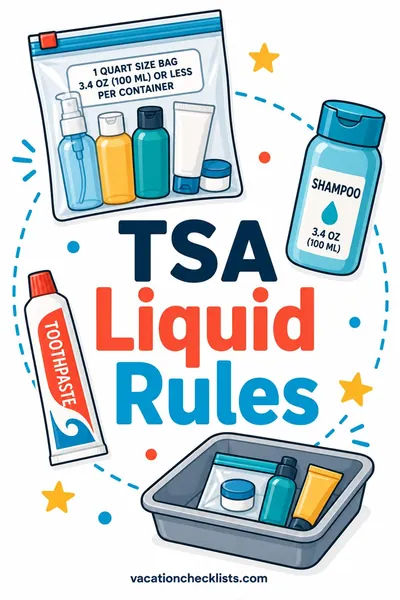
For the full liquid rules, including the exemptions for medication, breast milk, and baby formula, read our dedicated guide to the TSA liquid rules. This page stays on the process, and that one owns the 3-1-1 detail.
Bin Strategy: The Small Habits That Prevent Losses
Bins are where things disappear. A few habits fix it.
Do not put small loose items straight into a bin. Phone, wallet, keys, watch, and passport all go inside your carry-on or into a small pouch that goes into the bin as one object. One item to track instead of six.
Send the bag through last, and yourself right behind it. If your bag goes first and you get held at the scanner for a pat-down, your unattended bag sits on the far belt without you. Keep the gap small.
Use two bins, not four. One for the laptop, one for the coat and the shoes if required. Spreading your things across four bins triples the reassembly time and the chance of leaving something.
Move to the reassembly bench, not the end of the rollers. Grab everything, walk four steps, and repack there. Standing at the belt stuffing your laptop away while ten people wait behind you is how the line stops.
Do a final touch check before you walk off. Phone, wallet, keys, ID, boarding pass. Say it out loud if that helps. This is the single most common loss point in the airport.
Medications, Medical Devices, and Formula
These are screened differently, and you are allowed to say so.
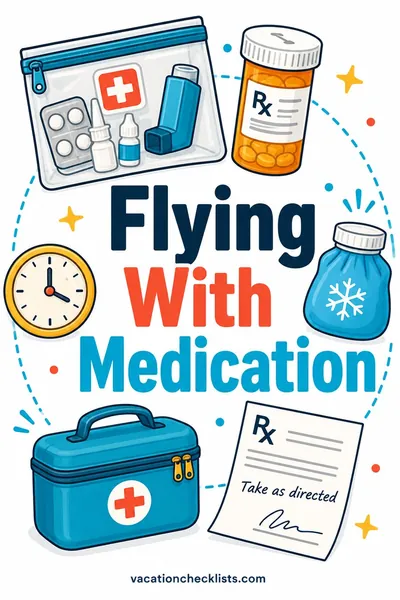
You can declare medically necessary items at the start of screening. Prescription and over the counter liquid medication, breast milk, formula, juice for an infant, and gel ice packs to keep them cool are handled outside the standard 3-1-1 limits in the US, in reasonable quantities. Take them out of your bag, tell the officer, and expect additional screening of those items.
Medical devices go in a separate bin or get inspected by hand. CPAP machines, insulin pumps, continuous glucose monitors, nebulizers, and ostomy supplies are all common and officers see them daily. Some devices should not go through the scanner at all, and your device manufacturer's guidance is the authority on that, not the airline and not us.
You can request a private screening at any point, and you can ask for the officer to change gloves before handling your items.
Practical points that make it smoother:
- Keep everything medical in one pouch so you can lift it out in one motion
- Bring more medication than the trip length in your carry-on, never in a checked bag
- A doctor's note is not required in the US, though it can help at foreign checkpoints
- Cooling packs are allowed for medically necessary items, and may be frozen solid
Our guide on flying with medication covers labeling, quantities, international rules, and the questions people actually get asked. Nothing here is medical advice, so talk to your prescriber about your own regimen and timing.
Power Banks and Spare Batteries
This one has tightened and travelers get caught out by it.
Under the ICAO rules in effect from 27 March 2026:
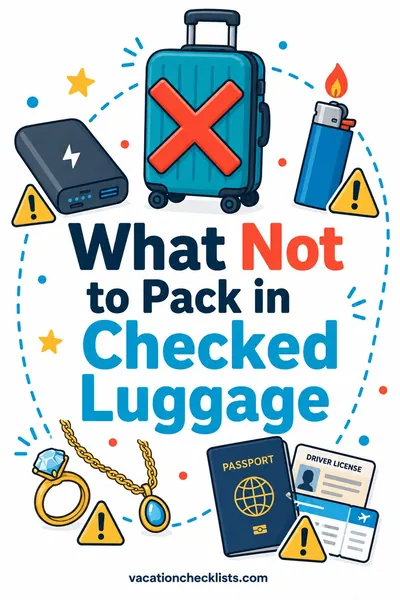
- Power banks and spare lithium batteries go in your carry-on only. They are prohibited in checked baggage.
- Two spares maximum per passenger.
- They must be accessible at your seat, not in the overhead bin, so a crew member can reach them quickly if one overheats.
- No in-flight charging. You cannot use a power bank to charge a device during the flight, and you cannot charge the power bank itself from an aircraft outlet.
- Under 100 watt-hours needs no approval. 100 to 160 Wh requires the airline's approval in advance. Over 160 Wh is banned from passenger aircraft entirely.
Practical translation: a typical 10,000 mAh phone power bank sits around 37 Wh, well under the free limit. A large laptop bank can approach or cross 100 Wh, so check the rating printed on the case before you fly. If it only shows mAh and volts, multiply them and divide by 1,000 to get watt-hours. A 20,000 mAh bank at 3.7 volts works out to 74 Wh.
Individual airlines can be stricter than the baseline, and several have added their own restrictions. The airline's own dangerous goods page is the authority for your flight.
What Not to Do at the Checkpoint
Short list, high stakes.
Do not joke about prohibited items. Not about bombs, not about weapons, not sarcastically, not to your friend, not quietly. There is no version of this that goes well. It can end in a missed flight, a fine, or a police interview, and the officers have no discretion to laugh it off.
Do not argue with an officer about a rule. If you think something is wrong, comply first and ask for a supervisor after. Debating at the belt costs you time, costs everyone behind you time, and does not change the outcome.
Do not assume another country's rules apply here, or that US rules apply abroad. Some airports require you to remove electronics you keep in at home. Some allow liquids you cannot bring here. Duty free bought abroad may be confiscated on a connection if it is not in a sealed security bag with the receipt visible. Check the departure airport's own guidance, not your memory of the last trip.
Do not pack a prohibited item to "see what happens." A confiscated multi-tool is a small loss. A referral is a large one. Run the item through the Can I Bring It? checker first.
Do not put your only ID somewhere you cannot reach. Since REAL ID enforcement began in May 2025, the ID you present has to be federally acceptable, which means a REAL ID compliant license, a passport, or another accepted document. Our travel document checklist covers what counts.
Timing: Get There Early Enough to Not Care
The best security tip is having enough time that a slow line is boring instead of terrifying. Wait times swing wildly by airport, terminal, day of week, and hour, and no single number is right everywhere.
Our guide on how early to arrive at the airport has the bag drop and gate cutoffs that actually set your timing, which is a different question from how long the security line looks. Read it once and set your alarm accordingly.
Two quick habits: check the airport's own wait time feed or app the morning of your flight, and if the airport has multiple checkpoints, look at whether a quieter terminal connects airside to your gate. Many do.
Traveling with Kids, Wheelchairs, and Head Coverings
Kids. Children 12 and under generally keep their shoes and light jackets on. Children under 13 can typically accompany an enrolled parent through the PreCheck lane. Strollers and car seats go through the X-ray if they fit, or get inspected by hand if they do not. Fold the stroller before you reach the belt, and carry the baby through the walk-through detector rather than in a carrier if asked. Formula, breast milk, and juice are all allowed in reasonable quantities above the liquid limits, declared at the start.
Wheelchairs and mobility devices. You never have to stand up or leave your device. Screening happens in the chair, with a pat-down and a swab of the hands and the device. Say what you need, including help with your belongings, and ask for a passenger support specialist if the process is not going well. Prosthetics, braces, and support devices stay on. Our guide to flying with a wheelchair covers the airline side of the trip.
Religious head coverings. You may keep them on through screening. If the scanner alarms on the head area, an officer may ask to pat down the covering. You can request that a same gender officer do it, and you can request a private screening rather than being touched in the open. Requesting privacy is routine and does not signal anything.
In all three cases the process is normal and staff handle it daily. Asking for what you need at the front of the line, before the divest table, is what keeps it smooth.
The Structural Fix: PreCheck, Global Entry, and CLEAR
Everything above shaves minutes. The programs change the line you stand in.
| Program | What it does | Where it helps |
|---|---|---|
| TSA PreCheck | Shorter, simpler screening lane. Shoes, belt, light jacket stay on. Laptops and liquids usually stay in the bag. | Departing US airports |
| Global Entry | Includes PreCheck benefits, plus expedited US customs and immigration on arrival from abroad | International returns |
| CLEAR Plus | Paid identity verification that moves you to the front of the document check queue, not a separate screening lane | Only at participating airports |
The distinction that trips people up: CLEAR gets you to the front of the ID line, PreCheck changes the screening itself. They stack, and neither replaces the other. If you fly internationally at all, Global Entry usually makes more sense than PreCheck alone because it includes PreCheck.
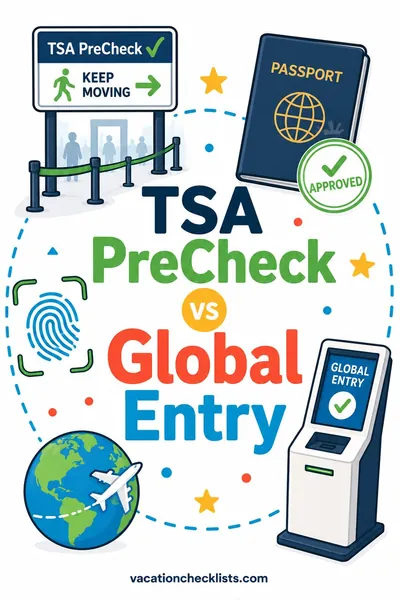
Our full comparison of TSA PreCheck vs Global Entry covers eligibility, the interview, the fees, and which cards reimburse the application. Check that before you apply for the wrong one.
Frequently Asked Questions
How early should I get to the airport for security?
That depends on the airport, the time of day, and your checked bag situation, and the bag drop cutoff usually matters more than the security line does. See our detailed guide on how early to arrive at the airport for the real cutoffs. As a habit, check the airport's published wait times the morning of your flight.
Do I still have to take my shoes off?
TSA ended the routine shoe removal requirement for standard screening at US airports in July 2025, and PreCheck travelers already kept shoes on. An officer can still ask you to remove them if something alarms. Other countries set their own rules, so expect to take them off at some foreign checkpoints regardless.
Can I bring a power bank on a plane?
Yes, in your carry-on only, and under the ICAO rules from 27 March 2026 you can carry two spares maximum, must keep them accessible at your seat, and cannot charge anything with them in flight. Under 100 Wh is fine, 100 to 160 Wh needs airline approval, and over 160 Wh is banned. Check the rating printed on your bank.
What is the fastest way through airport security?
Empty your pockets while standing in line, have your laptop and liquids in outside pockets, and wear no belt and easy shoes. That is most of it. Enrolling in TSA PreCheck or Global Entry is the bigger structural fix, since it changes which lane you stand in rather than just how fast you move through it.
Can TSA search my phone or laptop?
At the security checkpoint, screening is about the physical item, not the data on it. Customs and Border Protection at a border crossing operates under different authority and has broader powers to inspect electronic devices. Those are two separate agencies with two separate rulebooks, so do not assume what applies at one applies at the other.
What happens if I forget something is in my bag?
Usually your bag gets pulled for a secondary hand search, the officer finds the item, and you choose to surrender it, mail it, or take it back to your car if you have time. It costs you several minutes and possibly the item. A quick check in the Can I Bring It? checker the night before avoids most of these.
Can I take food through security?
Solid food is generally fine, including sandwiches, snacks, and baked goods, though officers may want a closer look. Anything spreadable, pourable, or spoonable counts as a liquid and falls under the 3-1-1 limits, which catches people out with yogurt, hummus, and jam. Our TSA liquid rules guide has the full list of what counts, and our guide to bringing food through airport security covers everything else.
Is CLEAR worth it if I already have PreCheck?
Only if you regularly fly out of airports where CLEAR operates and the ID check line is your actual bottleneck. PreCheck fixes the screening step, CLEAR fixes the document check step, and they solve different problems. If your home airport has short document lines but a slow standard checkpoint, PreCheck alone does the job.
Next step: check any questionable item with the free Can I Bring It? checker, build the bag around what has to come out with the free packing list generator, and read TSA PreCheck vs Global Entry if you fly more than twice a year.