Checked Bag Fees Explained

Most US airlines charge for the first checked bag on domestic economy tickets, charge more for the second, and add a separate penalty once a bag passes about 50 pounds or 62 linear inches. Prices vary by airline, route, fare class, and whether you pay online or at the counter, and they change often enough that any fee table published online is probably already wrong.
So this page does something more useful than listing numbers. It explains the pricing logic every airline uses, shows you the thresholds that trigger the expensive penalties, and gives you the honest math on avoiding fees. Then it sends you to each airline's own page for today's actual price.
Before you pay for a checked bag at all, make sure your carry-on genuinely fits. Measure it against your airline's real numbers with our free carry-on size checker, because a gate-check at the door costs more than a bag paid for online.
Updated August 2026. Baggage fees are set by individual airlines, not by TSA or any government agency, and they change several times a year. What you will find here are the weight and size thresholds, the fare rules and the pricing structure, all of which hold steady. Always read the current fee off your airline's own baggage page before you book, and note that the agent at the counter applies the airline's rules as written that day.
A note on numbers. No dollar figures on this page. Every US airline sets its own baggage fees, revises them several times a year, and prices them differently by route, by fare class and by where you pay, so a printed figure would be wrong for most readers and stale for the rest. What you get instead is the pricing logic, the weight and size thresholds that trigger the expensive penalties, and how to read today's real number off your own airline's baggage page in about a minute.
How Airlines Actually Price a Checked Bag
Every US airline builds the bag price out of the same five ingredients. Once you can see them, an unexpected charge stops being a mystery.
| Pricing factor | How it works | Typical effect |
|---|---|---|
| Bag number | First bag one price, second bag more, third and beyond a lot more | Second bag often 1.5x to 2x the first |
| Weight | A standard allowance, then penalty tiers above it | Overweight tiers often exceed the base fee itself |
| Size | Measured in linear inches (length + width + height) | Oversize penalty is usually the steepest single charge |
| Fare class | Basic economy, main economy, premium, business each get different allowances | Business and first often include one or two bags |
| Where you pay | Online during check-in vs at the airport counter | Airport price is commonly a step higher per bag |
There's a sixth factor that catches people out: status and card ownership override all of the above. A cardholder with a free-first-bag benefit pays nothing for a bag their seatmate is paying full price for, on the same flight, in the same cabin, on the same fare.
Book the bag when you book the ticket, or at online check-in at the latest. Paying at the counter is nearly always the most expensive way to check a bag, and it's the one decision entirely within your control.
The Thresholds That Trigger Extra Checked Bag Fees
These are the numbers that turn a normal bag into an expensive one. They're typical across major US carriers, and they do vary by airline, so treat them as the industry pattern rather than a guarantee.
| Threshold | Typical limit | What happens above it |
|---|---|---|
| Standard weight | 50 lb (23 kg) economy | Overweight fee begins at 51 lb |
| First overweight tier | 51 to 70 lb (23 to 32 kg) | A flat penalty, often similar to or larger than the base bag fee |
| Second overweight tier | 71 to 100 lb (32 to 45 kg) | A much larger penalty, and many airlines refuse this on some routes |
| Hard weight ceiling | Over 100 lb (45 kg) | Usually refused outright, must ship as cargo |
| Standard size | 62 linear inches (158 cm) | Oversize fee begins above this |
| Oversize tier | 63 to 80 linear inches | A flat penalty, frequently the largest single bag charge |
| Hard size ceiling | Over 80 linear inches (203 cm) | Usually refused, or handled as special or cargo items |
| Premium cabin weight | Often 70 lb (32 kg) | Business and first class frequently get a higher free weight |
Linear inches means length plus width plus height added together, including wheels and handles. A 29 x 20 x 12 inch suitcase is 61 linear inches, which passes. Add an inch to any side and it doesn't. Instrument cases often run past that limit, which our guide to flying with a musical instrument covers.
The cruel part is that overweight and oversize stack. A 55 pound, 65 linear inch bag can attract the base fee, an overweight penalty, and an oversize penalty on the same tag. That's how a single bag ends up costing more than the seat it's traveling with.
Worked Example: The Real Cost of One Heavy Suitcase
Take a family of four flying round trip on a domestic economy fare. Rather than quote figures that would be wrong by the time you read them, count everything in standard bag fees, where one standard bag fee is whatever your airline charges today for a first checked bag paid online. Look that one number up, and the rest of this example scales to your trip.
Scenario A, packed sensibly. Four bags, each 44 pounds and 60 linear inches, all paid online at booking.
- 4 bags outbound = 4 standard fees
- 4 bags on the return = 4 standard fees
- Total: 8 standard fees, and no penalties of any kind
Scenario B, one bag overpacked. Same trip, same family, but the parents consolidate their two suitcases into one 56 pound bag measuring 64 linear inches, and they pay at the airport counter instead of online.
- 3 bags at the counter, each way, at the counter rate rather than the online rate
- An overweight penalty on the heavy bag, each way, and that penalty is commonly as large as a standard bag fee or larger
- An oversize penalty on the same bag, each way, and oversize is usually the steepest single line on the tariff
- Total: on typical published tariffs, roughly two and a half times what scenario A pays
Scenario B carries fewer pieces of luggage than scenario A and costs well over twice as much. Consolidating into fewer, bigger bags is the single most expensive packing instinct there is, because airline pricing punishes weight and size far harder than it punishes bag count. Three bags at 44 pounds beat two bags at 60 pounds every time, on every carrier.
Run this yourself before you pack. Open your airline's baggage page, write down four numbers, and the whole decision falls out of them: the first bag rate online, the second bag rate, the first overweight tier, and the oversize charge. If the overweight and oversize lines together come to more than one extra bag rate, and they almost always do, you should be splitting the load rather than stacking it.
An inexpensive luggage scale pays for itself on the first trip. Weigh at home, and weigh again before the return flight, when souvenirs have quietly added eight pounds.
Basic Economy: Where the Traps Live
Basic economy is a real fare, not a scam, but it's priced to look cheaper than it is. Three specific traps:
- Some basic economy fares exclude the carry-on, not just the checked bag. On certain airlines and certain routes, you get a personal item only. If you turn up at the gate with a roller bag, you pay the gate rate, which is the highest rate the airline charges.
- Card and status benefits sometimes don't apply. A few airlines strip the free-checked-bag benefit on their most restrictive fares. Read the fare rules, not the card marketing.
- The bag is priced separately and often not discounted. Buying a basic economy ticket and adding a bag can cost more than the main cabin fare that included it.
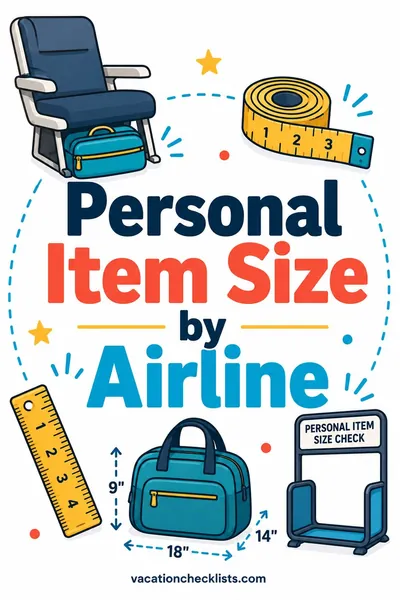
Do the comparison at booking. Add the bag to both fares, then compare the totals. Roughly half the time, the "expensive" fare is the cheaper trip. Our personal item size guide is worth a look if you're planning to fly with the smallest allowance, and the carry-on packing list shows what genuinely fits in one.
One important honest note: Southwest, long the industry exception with two free checked bags, began charging for checked bags in 2025. If you're working from older advice, that advice is out of date. Southwest publishes a 24 x 16 x 10 inch carry-on size including wheels and handles, but does not publish a personal item dimension, so there's no official number to measure a personal item against there. Check their current baggage page directly.
International Allowances Are a Different Rulebook
The same airline, the same aircraft, the same cabin, and a completely different bag policy, purely because of where the plane is going.
- Transatlantic and transpacific economy frequently includes one free checked bag, sometimes two, depending on the airline and the fare bundle.
- Latin America routes often allow one or two free bags in economy, with the allowance varying by country.
- Weight limits change too. Many international allowances are quoted in kilograms, commonly 23 kg for economy and 32 kg for premium cabins.
- Piece system vs weight system. North American and most transatlantic routes use a piece system, counting bags. Many carriers elsewhere use a total weight system, where your allowance is a number of kilos across all bags. Those work completely differently.
- The most restrictive segment usually wins. On an itinerary combining a long-haul flight with a domestic connection, the allowance often follows the operating carrier of the first marketed segment, but not always. This is genuinely inconsistent between airlines, so check when your booking involves two carriers.
Codeshare bookings are where people get burned. You bought a ticket from airline A, but airline B operates the flight, and airline B's baggage rules apply at their counter. Look at the operating carrier, not the logo on your confirmation email.
How to Avoid Checked Bag Fees, Honestly
Four methods actually work. Everything else is folklore.
1. An airline credit card with a free-bag benefit. Most major US airline cards include a free first checked bag for the cardholder and several companions on the same reservation. This is the most reliably valuable benefit in the category.
Run the math before you apply, using the card's own annual fee and your airline's own first-bag rate:
- Count the bag charges the benefit actually waives per round trip. A cardholder plus three companions on one reservation, checking one bag each, is eight waived charges a year on a single round trip.
- Multiply those waived charges by your airline's current first-bag online rate.
- Compare that total against the card's annual fee. For a family of four flying even once a year, the waived bags typically clear a mid-tier airline card's annual fee several times over.
For a solo traveler taking two round trips a year, the same arithmetic waives four bag charges, which lands close to a mid-tier annual fee rather than comfortably past it. Positive, but thin, and only if you fly that airline and actually check bags. If you're a carry-on-only traveler, the benefit is worth exactly zero and you should judge the card on everything else it offers.
2. Elite status. Most frequent flyer programs include free checked bags from the entry tier upward, often with a higher weight allowance at the top tiers. Free if you were flying that much anyway, wildly expensive if you weren't.
3. Buy a fare that includes the bag. Main cabin, premium economy, and business fares often bundle bags. As shown above, the bundled fare is regularly cheaper than the stripped fare plus the bag.
4. Don't check a bag. The unglamorous answer that beats all the others. A properly packed carry-on covers most trips up to a week. Use our packing list generator to build a list that actually fits in one.
Two things that do not work: wearing your heaviest clothes to the counter changes nothing about the bag's weight, and arguing about an ounce or two rarely helps. Agents do sometimes show discretion at 51 pounds, but that's a courtesy, not a rule, and you can't plan around it.
Where to Check Today's Actual Fees
Fees change often, sometimes multiple times a year, and often without much notice. Any static table on a third-party site goes stale fast. Go to the source:
- American Airlines: aa.com baggage policy
- Delta: delta.com baggage
- United: united.com baggage
- Southwest, Alaska, JetBlue, Hawaiian, Frontier, and Allegiant each publish their own baggage page under "travel info" or "baggage."
Enter your exact route and fare class, because the same airline's page will quote you different numbers for different itineraries.
One rule that is not set by the airline and is worth knowing: under a US Department of Transportation rule finalized in 2024, airlines must refund your checked bag fee if the bag is substantially delayed, with the qualifying delay window depending on whether the flight is domestic or international. Airlines don't volunteer this refund. You have to claim it. Details are on transportation.gov.
What Not to Put in the Bag You're Paying For
If you're going to pay for a bag at all, it's worth knowing what shouldn't be in it. Some items are restricted by regulation, others just shouldn't be out of your sight.
Spare lithium batteries and power banks are the clearest example. Under ICAO rules effective 27 March 2026, spare power banks are carry-on only, capped at two per passenger, must stay accessible at your seat rather than in the overhead bin, and cannot be charged or used to charge devices in flight. Under 100 Wh needs no approval, 100 to 160 Wh requires airline approval, and above 160 Wh is banned from passenger aircraft entirely. This is an international rule that individual airlines can be stricter about, so check yours.
Also keep out: medication, valuables, documents, chargers, and one change of clothes. Our full guide to what not to pack in checked luggage covers the restricted list and the practical one.
Frequently Asked Questions
How much is a checked bag on a domestic flight?
On most major US airlines, the first checked bag on a domestic economy ticket carries a fee that the airline sets itself and revises several times a year. The second bag costs more than the first, and paying at the airport counter costs more than paying online at check-in. Because the number moves by airline, by route and by fare class, the only reliable answer is the one on your own airline's baggage page. Enter your exact itinerary there, since the same carrier quotes different amounts for different routes.
What happens if my bag is over 50 pounds?
You'll pay an overweight fee on top of the standard bag fee, usually starting at 51 pounds. The penalty is often as much as or more than the base fee, and it climbs sharply above 70 pounds. Most airlines refuse bags over 100 pounds outright. Repacking a few items into a second bag or your carry-on at the counter is almost always cheaper than paying the penalty.
Do checked bag fees apply on international flights?
Often not, or not for the first bag. Many long-haul economy fares include one or two checked bags, and allowances differ by region, airline, and fare bundle. The rules on international routes are genuinely different from the same airline's domestic policy, so check the specific itinerary rather than assuming.
Is an airline credit card worth it just for the free bag?
It depends entirely on how many people you fly with and how often. A family of four checking bags on one round trip a year typically waives enough bag charges to clear a mid-tier airline card's annual fee several times over. A solo carry-on-only traveler saves nothing at all. Count the bag charges the benefit would actually waive across a realistic year of your own flying, multiply by your airline's current first-bag rate, and compare that against the card's annual fee before you apply.
How do I measure linear inches for an oversize check?
Measure the length, width, and height of the packed bag, including wheels, handles, and any external pockets, then add the three numbers together. Under 62 inches is the standard limit. Measure the bag when it's full, since a soft-sided bag grows once it's packed.
Can I pay for a checked bag at the gate?
Sometimes, but it's the most expensive option and on some fares the gate rate is substantially higher than the online rate. If you're already at the gate with a bag that won't fit, you'll usually be gate-checking it rather than checking it normally. Pay online during check-in whenever you can.
Does basic economy include a carry-on?
On most airlines yes, but on some airlines and some routes, basic economy allows only a personal item that fits under the seat. This differs by carrier and has changed several times in recent years. Read the fare rules on the booking page before you buy, because the gate fee for a surprise roller bag is steep.
Do I get my bag fee back if the airline loses my luggage?
Under a US Department of Transportation rule finalized in 2024, airlines must refund the checked bag fee when a bag is substantially delayed, with different qualifying windows for domestic and international flights. The refund is not automatic. File the claim with the airline and keep your bag tag receipt and file reference number.