TSA PreCheck Cost: What the Fee Covers and Who Pays

The TSA PreCheck cost is a single, one time fee that buys a five year membership. There is no monthly charge, no subscription, and nothing extra to pay after it. The exact amount depends on which TSA approved enrollment provider you use, and online renewal is normally cheaper than a brand new enrollment. The fee is nonrefundable whether or not you are approved, and it covers one person only.
You will notice there are no dollar figures anywhere on this page, and that is deliberate. This is a government program fee set by TSA and its approved providers, it has been adjusted more than once, and providers price against each other. A number typed here would quietly go stale and give you false confidence. What this page gives you instead is everything the number does not tell you: what the fee actually buys, the five routes that get it at no cost, how it stacks up against Global Entry and CLEAR, and the break even arithmetic you can run yourself in about a minute.
Read the current fee at the source. TSA publishes the enrollment and renewal amounts at tsa.gov/precheck, and each approved provider publishes its own. Check both before you book an appointment, because that is the only figure that will be right on the day you pay.
If you are still fuzzy on what the program does, our guide to what TSA PreCheck is covers how the lane works. And since PreCheck lets more stay inside your bag, use our free Can I Bring It? checker to make sure what is in there is allowed.
Updated September 2026
TSA PreCheck cost by enrollment provider
For years there was exactly one company you could enroll through. TSA has since approved additional enrollment providers, and they set slightly different prices and operate different networks of locations. That is why you will see two different numbers quoted online and both are right.
| Route | How the price compares | Term | Notes |
|---|---|---|---|
| New enrollment, largest provider | The low end of the published range | 5 years | Biggest network of enrollment centers |
| New enrollment, other approved providers | Slightly above the low end | 5 years | Sometimes much better appointment availability |
| Online renewal | Below a new enrollment | 5 years | No second fingerprint visit in most cases |
| In person renewal | Same as that provider's renewal price | 5 years | Needed if you have been lapsed a long time |
IDEMIA has historically run the largest enrollment network at the lower end of that range, and Telos has been the other widely available approved provider at the higher end. Both are legitimate, and both deliver the identical membership. Pick on appointment availability near you, not on the small difference in price, because a slot next Tuesday is worth more than a small saving on the fee.
Two things to know before you pay:
- The fee is charged at the appointment or at submission, and it is nonrefundable. If TSA denies you, the money is gone. Read the disqualifying offense list on tsa.gov first.
- One fee covers one person. There is no family rate and no couple discount.
How to check the real number before you pay
- Open tsa.gov and read the published enrollment fee and the published renewal fee. They are different amounts.
- Open each approved provider's enrollment page and read their price for your state.
- Check whether you are eligible for one of the no cost routes in the next section, because that changes the answer entirely.
- Check whether Global Entry, which includes PreCheck, is worth the difference for you. Compare the two published fees against each other, not against a number you read somewhere.
- Only then book the appointment, and pay through the provider reached from tsa.gov rather than through a search ad.
What the TSA PreCheck fee actually buys
The fee covers vetting, fingerprinting, and five years of membership. Specifically, you get:
- Access to the PreCheck screening lane at participating US airports, where shoes, belt, and a light jacket stay on and your laptop and liquids stay in the bag.
- A Known Traveler Number, or KTN, that you add to airline reservations.
- Children 12 and under travel with you, with no membership of their own, when they are on your reservation.
- Five years, dated from approval, with an email reminder as the expiry approaches.
What the fee does not buy, and this is where disappointment comes from:
- It is not customs. Coming home from abroad, PreCheck does nothing at all. That is Global Entry.
- It is not the ID line. You still queue to show your ID and boarding pass. That is the job CLEAR does.
- It is not lounge access, priority boarding, or anything past the checkpoint. For that, see our guide to airport lounge access.
- It is not a guarantee the lane is open. Smaller airports staff the PreCheck lane only during peak banks, and a closed lane saves you nothing that morning.
- It is not valid outside the US. Foreign checkpoints run their own rules.
The five routes where the cost is zero
A meaningful number of travelers pay full price for something they could have had free. Work through this list before you enter a card number.
Active duty military and DoD personnel. Members of the US Armed Forces, including reserves and National Guard, have generally been able to use PreCheck benefits at no cost by entering their DoD ID number as their Known Traveler Number in airline reservations. Cadets, midshipmen, and Department of Defense civilian employees have historically been covered the same way. There is nothing to apply for and nothing to pay.
Federal employees under HSPD-12. Staff at a number of federal agencies, including DHS and the Coast Guard, get access through their agency rather than through a public application.
Travel credit cards. A large number of travel rewards cards reimburse a PreCheck or Global Entry application fee as a statement credit, typically once every four or five years. If you hold one, your effective cost is zero. Two things worth checking in your own card's terms:
- Whether the credit covers the full Global Entry fee rather than only the smaller PreCheck one. Most do, and since Global Entry includes PreCheck, using the credit on the bigger program is usually the better move.
- Whether you can pay for a family member's application on your card and still trigger the credit. Some cards allow it, and that is how couples end up with two memberships for nothing.
Employers. Plenty of companies reimburse it for anyone who flies for work, and the policy is often buried where nobody reads it. Ask your finance or travel team before you pay. Our business trip packing list covers the rest of what makes work travel less painful.
Airline and hotel loyalty points. Some programs let you redeem points for an application fee credit. The redemption value is usually mediocre, so treat it as a way to use up an orphan balance rather than a smart use of points.
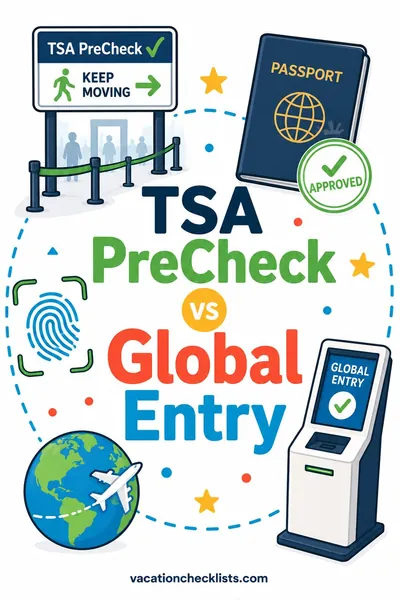
PreCheck vs Global Entry vs CLEAR
This is the comparison that costs people the most money, because the three programs get confused constantly.
| TSA PreCheck | Global Entry | CLEAR Plus | |
|---|---|---|---|
| How it is priced | One flat fee | One flat fee, modestly higher than PreCheck | An annual subscription, several times PreCheck's yearly equivalent |
| Term | 5 years | 5 years | 1 year, auto renewing |
| Run by | TSA, a government agency | CBP, a government agency | A private company |
| Speeds up US departure screening | Yes | Yes, it includes PreCheck | No |
| Speeds up US arrival customs | No | Yes | No |
| Speeds up the ID check line | No | No | Yes, that is its whole job |
| Available at | Most US airports | US arrival airports | Selected airports only |
Three conclusions come straight out of that table.
Global Entry is the better buy for a modest difference over five years. It includes every PreCheck benefit and adds the customs lane. If there is even one international trip in your next five years, pay the difference. Our TSA PreCheck vs Global Entry comparison goes deeper, and how to apply for Global Entry walks through the process.
CLEAR replaces neither. CLEAR walks you to the front of the document check queue and then hands you back to whichever screening lane you are entitled to. Buying CLEAR instead of PreCheck is the expensive mistake in this category, and it is the only one of the three that bills you every year for as long as you keep it. Buying it as well as PreCheck is a reasonable choice at a handful of very busy hubs, and pointless at most airports.
Never buy PreCheck if you already have Global Entry. You already have PreCheck. This happens more often than you would think, and the fee is nonrefundable.
The break even math, by how much you fly
Here is the honest version, with the assumptions written down instead of hidden. You supply one number, the current fee, and the arithmetic does the rest.
One round trip means two airport departures, since you go through security in both directions. So the cost per departure is simply the fee divided by the number of departures you will actually make in five years.
| Round trips per year | Departures over 5 years | Divide the fee by |
|---|---|---|
| 1 | 10 | 10 |
| 2 | 20 | 20 |
| 4 | 40 | 40 |
| 6 | 60 | 60 |
| 10 | 100 | 100 |
| 20 | 200 | 200 |
Do that division once with the current published fee and you will have your answer faster than any article can give it to you. For most people flying twice a year or more, the per departure figure lands somewhere between a coffee and a soda, and the argument is over.
Worked example: putting a number on the time
Assume the lighter procedure saves you eight minutes on a typical departure. That is a planning figure, not a published statistic, and using an assumption you can adjust is the honest way to do this: wait times swing wildly by airport, terminal, day, and hour, and there is no single true number.
At six round trips a year:
- 60 departures over five years
- 60 x 8 minutes = 480 minutes saved, or 8 hours
- Divide the fee by 8 to get what an hour of your time cost you
At two round trips a year:
- 20 departures x 8 minutes = 160 minutes, or 2 hours 40 minutes
- Divide the fee by 2.67 for the hourly figure
At one round trip every two years:
- 5 departures over five years x 8 minutes = 40 minutes
- Divide the fee by 0.67, which is why this traveler almost never comes out ahead
Now plug in your own numbers. If your home airport is a small one where the PreCheck lane is often closed, drop the eight minutes to three and see what happens to the hours. If you fly out of a big hub at 7am on Mondays, eight minutes is probably conservative.
The rough rule that falls out of this: two or more round trips a year out of a decent sized US airport and PreCheck pays for itself in aggravation alone. One trip every couple of years and it is a luxury purchase, not a value one.
There is a second saving that does not show up in minutes. The lighter divest procedure means fewer chances to leave a laptop in a bin, which is how a lot of expensive electronics get lost at checkpoints. Not unpacking is worth something on its own.
What it costs a family
There is no family pricing, so a household budget is simple multiplication with one useful exception: children ride along free.
| Household | Memberships you actually pay for |
|---|---|
| Solo traveler | 1 |
| Couple | 2 |
| Two adults, two kids aged 8 and 10 | 2, since the kids ride along |
| Two adults, two teens aged 14 and 16 | 2, since teens usually ride along on the same booking |
| Two adults, one adult child aged 19 | 3 |
Children 12 and under can generally use the PreCheck lane with an enrolled parent or guardian, and teens 13 to 17 can usually come along when they are on the same reservation and the PreCheck marking prints on their boarding pass. Anyone 18 or over needs their own membership. That rule has been adjusted before, so confirm it on tsa.gov in the year you are flying.
Everyone has to be on the same reservation for the marking to carry across to the kids. Separately booked tickets often break it, which is a good reason to book the family together even when a split booking is slightly cheaper.
Global Entry works the opposite way for families: there, every traveler needs their own membership, including infants, so a family of four is four applications and four fees.
Renewal, and the money you waste by being late
Renewal is where people accidentally pay twice.
- Online renewal usually costs less than a new enrollment, and normally skips a second trip to an enrollment center because your fingerprints are on file.
- Your KTN normally stays the same, so you do not have to update every airline profile again.
- TSA has offered an auto renewal option to some members. If you would rather never think about this again, look for it when you enroll or renew.
- Let it lapse long enough and you can be pushed back to a full in person enrollment, at the higher new enrollment price plus another appointment.
The other cost of being late is invisible and worse: an expired KTN just silently stops printing PreCheck on your boarding pass, and you find out on a morning you are already running behind. Put the expiry date in your calendar with a six month warning the day you are approved.
Global Entry renewal follows different rules, including a grace period for members who file before expiry. Our Global Entry renewal guide has that timing.
Four ways people waste money on this
- Paying a third party application service. Sites offer to help with your application and charge a markup for typing a form you can finish yourself in fifteen minutes. Enroll through a TSA approved provider directly, reached from tsa.gov.
- Buying PreCheck when a card would have paid for Global Entry. Check your wallet before you check out.
- Buying CLEAR expecting PreCheck benefits. Different problem, different product, and a recurring annual bill instead of a one time fee.
- Paying, then never adding the KTN to bookings. The most expensive mistake of all, because you pay full price for nothing. Add it to your airline profile the day it arrives.
For more of this kind of thinking, our guide on how to save money on travel covers the fees that are worth paying and the ones that are not.
So, is the TSA PreCheck cost worth it?
Short version by traveler type:
- Two or more round trips a year, domestic only. Yes. Buy it.
- Any international travel in the next five years. Buy Global Entry instead, since the difference over five years is small and it includes PreCheck.
- A credit card with a fee credit. It is free, so use the credit on Global Entry and stop thinking about it.
- Active duty military or DoD. You likely already have the benefit. Enter your DoD ID number as your KTN.
- One trip every couple of years from a small airport. Probably not worth it. Get the free version of the speed with our airport security tips.
- Family of four flying twice a year. Enroll the two adults and the kids ride along.
Frequently asked questions
How much is TSA PreCheck right now?
The fee is set by TSA and by each approved enrollment provider, and it has changed more than once, so read it at tsa.gov and on the provider's own enrollment page before you book. What holds steady is the structure: one nonrefundable fee, one person, five years, with online renewal priced below a new enrollment. Anything you see quoted elsewhere is a snapshot of a past price.
How much does TSA PreCheck renewal cost?
Online renewal has consistently cost less than a new enrollment, and it usually skips a return trip to an enrollment center because your fingerprints are already on file. Your Known Traveler Number normally stays the same. If your membership lapsed a long time ago, you may be pushed back to a full in person enrollment at the higher new enrollment price.
Is TSA PreCheck cheaper than Global Entry?
Yes, but by a smaller margin than most people expect over a five year term, and Global Entry includes PreCheck while adding expedited US customs on international arrivals. That makes Global Entry better value for almost anyone who leaves the country even once in five years. PreCheck alone makes sense mainly for strictly domestic travelers who want the fastest approval.
Does TSA PreCheck cost anything per year after the fee?
No. It is a single fee covering five years, with no annual charge, no subscription, and no renewal billing unless you opt into an auto renewal program. That is the main structural difference from CLEAR, which is billed yearly and adds up to far more over the same period.
Can I get TSA PreCheck for free?
Often, yes. Active duty military and DoD personnel generally get the benefit at no cost using their DoD ID number as a Known Traveler Number, certain federal employees are covered by their agency, many travel credit cards reimburse the fee in full, and plenty of employers pay for staff who fly for work. Check all four before paying anything.
Do my kids each need to pay for TSA PreCheck?
Children 12 and under can generally use the lane with an enrolled parent or guardian at no cost, and teens 13 to 17 can usually come along on the same reservation when the PreCheck marking prints on their boarding pass. Anyone 18 or over needs their own paid membership. Global Entry is different: everyone needs their own, including infants.
Is the TSA PreCheck fee refunded if I am denied?
No. The fee covers the vetting and processing, so it is charged and kept whether the answer is yes or no. That is why it is worth reading TSA's list of disqualifying offenses and answering every question on the application honestly and completely before you pay.
Does PreCheck cost more at the airport enrollment centers?
The price is set by the enrollment provider, not by the location, so an airport center run by a given provider charges the same as that provider's pharmacy or office park location. Choose on appointment availability and convenience instead. Our guide on how early to arrive at the airport covers timing if you are combining the appointment with a flight.
Next step: compare the two government programs in TSA PreCheck vs Global Entry before you pay, read what TSA PreCheck is if you want the full picture of how the lane works, and check anything questionable in your bag with the free Can I Bring It? checker.