How to Protect Valuables While Traveling Abroad

The short answer to how to protect valuables while traveling is that you protect them mostly by not bringing them. After that, the rule is simple: anything you cannot replace, cannot cancel, or cannot fly home without stays on your body or in your carry-on, never in a checked bag and never loose in a hotel room. Split what's left across two places so one bad moment cannot take everything.
That's the whole system. The rest of this page is how to run it without turning your vacation into a security detail.
Not sure whether a camera, a power bank, or a wedding ring can go in a checked bag at all? Check the item first with our free Can I Bring It? tool, because some of these have actual federal rules attached, not just advice.
Updated September 2026. Airline liability for checked baggage is set by each carrier's contract of carriage and by international treaty, and battery rules come from the FAA. Check the FAA PackSafe pages for batteries and your airline's own contract of carriage for baggage liability limits.
Start by Deciding What Actually Counts as a Valuable
Most people picture jewelry. In practice, the thing that ruins a trip is almost never the necklace.
A valuable, for travel purposes, is anything in one of four buckets:
- Irreplaceable on the road. Your passport, your prescription medication, your glasses, your custom orthotics. Money cannot fix these quickly in a foreign city.
- Expensive and portable. Laptop, camera body and lenses, tablet, headphones, watch, jewelry, hearing aids.
- Financially live. Debit and credit cards, cash, your phone with your banking apps and your two-factor codes on it.
- Sentimental. Your grandmother's ring. There is no insurance payout that fixes losing it in a hostel.
Rank your own list in those buckets before you pack. Bucket 4 mostly should not come. Bucket 1 gets the most protection. Bucket 2 is what thieves actually target.
How to Protect Valuables While Traveling: The Layered System
Think of this as four layers, each one covering the failure of the one before.
| Layer | What it does | What it looks like in practice |
|---|---|---|
| 1. Leave it home | Removes the risk entirely | Real jewelry, spare cards, the good watch, anything sentimental |
| 2. Split it up | Stops one theft from taking everything | Two cards in two bags, cash in three places, a backup ID separate from the passport |
| 3. Secure it in place | Slows down opportunistic theft | Locked room safe or front desk box, locking zippers, cable lock on a laptop |
| 4. Recover it | Limits the damage after a loss | Find My enabled, card app on the phone, photos of serial numbers, insurance policy number saved offline |
Almost everybody does layer 3 and skips layers 2 and 4. Layer 2 is the cheapest insurance you will ever buy and it costs nothing but two minutes of packing thought.
What Never Goes in a Checked Bag
This is the part with real rules behind it, not just opinion.
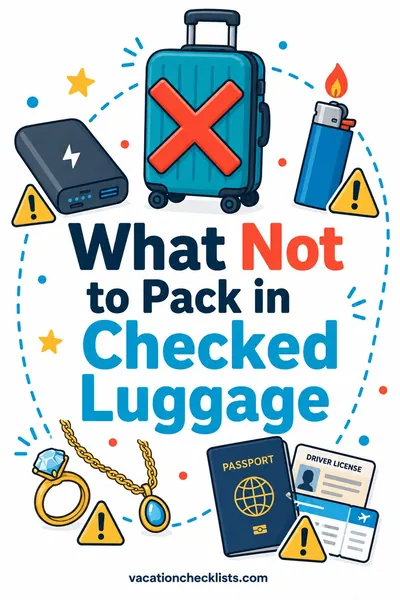
Federal rules. Spare lithium batteries and power banks are not allowed in checked baggage. They have to be in your carry-on, terminals taped or in a sleeve, because a fire in the cargo hold is unfightable. E-cigarettes and vapes are carry-on only for the same reason.
Contract rules. Read any airline's contract of carriage and you'll find a list of items they explicitly exclude from liability if checked: cash, jewelry, cameras, computers, electronics, documents, keys, medication, and heirlooms. If your laptop vanishes from a checked bag, the airline's position is that you were told not to check it. On international itineraries, liability for checked baggage is also capped by treaty, and the cap is not generous.
Practical rules. Checked bags are handled by a lot of people, out of your sight, in a lot of places. That's not a moral judgment on baggage handlers, it's just a long unsupervised chain.
So the checked-bag rule is short. Clothes, shoes, toiletries, souvenirs you could replace. Nothing else.
Our guide to what not to pack in checked luggage covers the full list, including the items that are banned outright rather than just unwise.
Hotel Safes: Useful, but Not What You Think
In-room safes stop the casual problem: housekeeping turnover, a friend of a friend in your room, someone who slipped through a propped door. They do not stop a determined person, because most have a manager override code and some hotels manage those codes poorly. A few models can be opened with a default factory code if staff never changed it.
Use the room safe anyway. Then adjust for what's inside:
- Passport, backup card, spare cash, tablet. Room safe is fine.
- Anything you genuinely could not absorb losing. Ask for the front desk safety deposit box. It usually comes with a signed receipt, and a receipt is what turns a loss into a claim.
- Laptop you're leaving in the room. Cable-lock it to something fixed, or take it with you.
Two habits that cost nothing. First, test the safe before you load it: set a code, lock it, open it, and only then put anything in. A safe that jams with your passport inside on a checkout morning is a genuinely bad hour. Second, put one shoe in the safe with your things. You will not leave the room on your last morning wearing one shoe, and that solves the most common way people lose valuables abroad, which is forgetting them.
More on room selection, door security, and the arrival routine in our hotel safety tips.
Money and Cards: Split Everything
The goal is that a stolen wallet is annoying, not trip-ending.
Carry two cards from two different banks, ideally two different networks. One Visa, one Mastercard, is a real thing, because some foreign terminals and some banks' fraud systems behave differently. Keep them in two different places. Card A in your wallet, card B in the room safe.
Cash in three places. A small day amount in your pocket. A larger reserve in the safe. A folded emergency note somewhere unlikely, a jacket lining, a toiletry bag, a phone case.
Use the card, not the ATM, where you can. Every ATM visit is a moment where you stand still with cash in your hand. When you do use one, pick a machine inside a bank branch during business hours rather than a standalone box on a tourist street.
Always pay in the local currency. If a terminal offers to charge you in dollars, decline. That's dynamic currency conversion and the exchange rate is set against you. Our page on common travel scams goes through this one and the rest.
Put your card issuer's app on your phone and know how to freeze the card in it. Freezing takes seconds. Calling an international support line from a foreign SIM takes considerably longer.
Your Phone Is the Most Valuable Thing You're Carrying
Not because of what it costs. Because of what's on it: your email, your banking apps, your two-factor codes, your photos, and increasingly your boarding passes and hotel keys. A stolen phone with a known passcode is a much worse event than a stolen wallet.
Set these before you leave:
- A real passcode, six digits or alphanumeric, not four. Biometrics are convenient, but the passcode is the fallback, and thieves in several cities specifically watch people type theirs in before grabbing the phone.
- Find My iPhone or Find My Device, on, with location services enabled.
- A SIM PIN, so a thief cannot move your number to another handset and start intercepting verification codes.
- Screen time or a similar lock on your account settings so the passcode alone doesn't let someone change your recovery email.
- Automatic cloud backup run the night before you fly. If the phone is gone, everything on it should already exist somewhere else.
- Auto-connect to open wifi turned off, and a habit of using cellular data or an eSIM for anything involving a password.
Our guide to traveling with electronics covers batteries, chargers, and screening rules for the hardware side.
Bags and Wearables That Actually Help
Anti-theft gear is oversold, but a few things earn their space.
| Item | What it prevents | Worth it? |
|---|---|---|
| Crossbody bag worn in front, zippers facing your body | Bag snatch, casual pickpocketing | Yes, the single best change most people can make |
| Locking or clipped zipper pulls | Quiet unzipping in a crowd | Yes, they buy you the seconds you need to notice |
| Money belt under clothing | Total wallet loss | Yes, for transit days and passports, not for daily cash |
| Slash-proof strap | Cut-and-run theft on a scooter | Situational, useful in a few specific cities |
| Bluetooth tracker in your suitcase | Airline losing your bag, not theft | Yes, for finding a delayed bag faster than the airline can |
| RFID-blocking wallet | Contactless card skimming | Marginal, chip cards use single-use codes and this attack is rare |
The behavior beats the gear. A cheap bag worn across the body in front of you is safer than an expensive anti-theft backpack worn on your back in a crowded metro.
Two rules that prevent most of it: never put a bag on the back of a restaurant chair, and never set a phone face down on a cafe table. Those two positions account for an enormous share of tourist theft in European cities.
Documents: Copies, Backups, and the Passport Question
Should you carry your passport or leave it in the safe? It depends on the country. Some countries legally require you to carry identification at all times, and police do check. Others don't care. Look up your destination on the State Department country information page before you decide, because guessing wrong in either direction has a cost.
Where it's not legally required, leave the passport in the safe and carry a photocopy plus a driver's license. Where it is required, a passport card is a good compromise if you have one.
Make three copies of everything, in three formats:
- A photo of your passport data page, your visa, your insurance card, and both credit cards, front and back, stored in your phone's secure notes
- The same set emailed to yourself, so it survives the phone being stolen
- One paper photocopy in your suitcase, separate from the originals
Photograph the serial numbers of your camera and laptop too. Insurance claims and police reports both ask for them, and neither is a good moment to be guessing.
If the worst happens, our guide to a lost passport abroad walks through the embassy process step by step.
Worked Example: Ten Days in Southern Europe, Two Travelers
Here's what the layered system looks like on a real trip.
Left at home. Wedding rings, replaced with plain silver bands for the trip. The good camera, replaced by the phone. One of the two credit cards each person owns.
In the checked bag. Clothes, shoes, toiletries, an empty packable duffel for souvenirs. Nothing else.
In the carry-on. Two laptops, both power banks, all medication in original bottles, both passports, chargers, and the jewelry that did come.
Split for the trip. Person A carries card 1 and the day cash. Person B carries card 2 and a second small day amount. The reserve cash and the backup card sit in the hotel safe with the passports, because Italy is a carry-ID country and they carry passport cards instead.
On the phones. Passcodes changed from four digits to six before leaving. Find My on. SIM PIN set. Both banking apps installed and tested. A full backup run the night before the flight.
On day six, person A's phone is lifted from a table in a cafe in Naples. Here's what that costs them: about 40 minutes.
They open Find My on person B's phone and mark the device as lost, which locks it immediately. They freeze card 1 in the bank app on person B's phone. They walk to the nearest police station and file a report, which they need for the insurance claim. They buy a cheap handset and put a local eSIM on it that afternoon. The passport, the reserve cash, and the backup card were never in play, because they were in the safe.
Same theft without the system: one phone, one wallet, both cards, the day cash, and their only copy of the trip photos, plus a passport if it had been in the bag.
The First Hour After a Theft
Order matters here.
- Get safe first. Move to a lit, populated place. Do not chase anyone.
- Lock the phone remotely via Find My or Find My Device, and mark it lost. Don't remote wipe yet, because a locked phone can still be located and a wiped one usually cannot.
- Freeze the cards in the issuer apps, or call using the international number you saved offline.
- File a police report, the same day. Nearly every travel insurance policy requires one, often within 24 hours, and you need the report number. Photograph the report before you leave the station.
- Change the passwords for your email and your bank from a trusted device, especially if the phone was unlocked when it was taken.
- Contact the embassy if a passport was taken.
- Notify your insurer and start the claim while the details are fresh.
Save your card issuers' international collect-call numbers and your insurance policy number in a note that lives offline, and on that paper copy in your suitcase. The moment you need them is the moment you don't have a phone. Our page on travel insurance explained covers what personal-effects cover does and doesn't include, and the receipt and report requirements that trip up claims.
Frequently Asked Questions
How do I protect valuables while traveling if my hotel has no safe?
Use the front desk. Most properties without in-room safes have a safety deposit facility behind the desk, and it typically comes with a receipt, which is better documentation than a room safe gives you. Otherwise, split the risk: carry your passport and one card on your body, and lock the rest inside your suitcase with a small padlock, which stops opportunistic hands even though it stops nothing determined.
Is it safe to leave a laptop in a hotel room?
It's safer than carrying it around a city all day, if you take two steps. Cable-lock it to a fixed fitting, and put the "do not disturb" sign on the door so the room stays closed. Make sure it's encrypted and backed up before the trip, so the worst case is losing the hardware rather than the data.
Should I bring my real jewelry on vacation?
No, for the reason that has nothing to do with theft: you will not enjoy wearing it. You'll take it off to swim, worry about it in the safe, and check for it every time you leave a room. Bring inexpensive versions, keep the real pieces at home, and remove the whole category from your trip.
Do money belts still work?
For their actual job, yes. A money belt is for the things you touch once a day, like a passport, a backup card, and reserve cash, on transit days when you're moving through crowded stations. It's a bad daily wallet, because digging into your waistband to pay for coffee shows everyone exactly where your money lives.
What's the safest way to carry cash abroad?
In several small amounts rather than one large one. Carry only what you'll plausibly spend that day, keep the reserve locked up, and hide a genuine emergency note somewhere you would never casually open. Use ATMs inside bank branches during business hours, and always choose to be charged in the local currency rather than in dollars.
Are AirTags and Bluetooth trackers worth putting in luggage?
Yes, though for the mundane reason rather than the dramatic one. They rarely help you recover stolen goods, because trackers only report when they pass another device from the same network. They're excellent for telling you that your delayed suitcase is sitting in the airport you connected through, which lets you tell the airline exactly where to look. Our luggage tracker guide covers how to set one up.
Does travel insurance actually cover stolen electronics?
Partly. Personal-effects cover usually has a per-item limit that a laptop or a camera body exceeds, so read the schedule rather than the headline. Nearly all policies require a police report filed within a set window, most exclude items left unattended in a public place, and many exclude anything you checked into the hold. Photograph your receipts and serial numbers before you travel.
The Two Minute Version
Leave the irreplaceable things home. Put anything expensive, electronic, medical, or financial in your carry-on, never the checked bag. Carry two cards from two banks in two places, and split your cash three ways. Use the safe, but use the front desk for the things that would genuinely hurt. Set a six-digit passcode, turn on Find My, set a SIM PIN, and back up your phone the night before you go. Save your bank's international number and your policy number offline. Wear your bag in front of you.
Do that once, at packing time, and you never have to think about it again on the trip. Start by running each item you're unsure about through our Can I Bring It? checker so nothing valuable ends up in the hold by accident.