How to Travel Carry-On Only

Here is how to travel carry on only, in one paragraph: pack four days of clothing in one color family, do a sink wash or a laundromat run every fourth day, wear your bulkiest shoes and jacket on the plane, keep every liquid at travel size, and measure your bag against your specific airline's box before you leave the house. Trip length barely matters after that. A four-day trip and a three-week trip use the same clothing pile, because the variable is laundry, not duration.
Check your exact bag against your airline's published limits with our free carry-on size checker before you pack a single thing. The size is where carry-on-only plans actually fail, and it fails at the gate where it costs the most.
Updated September 2026. Cabin bag dimensions, weight limits, and personal item rules are set by each airline and change. Every figure below is the airline's own published number, and the checker links to each carrier's official baggage page so you can confirm before you fly.
Why Carry-On Only Is Worth the Discipline
The upside is not just saving a bag fee. It is the rest of it.
- Your bag cannot get lost. It is above your head. Mishandled bags are rare per flight and extremely common per traveler over a lifetime, and they cluster on tight connections.
- You skip two lines. No bag drop on the way out, no carousel on the way in. That is often 45 minutes to an hour per trip.
- A missed connection is survivable. If you get rebooked, you and your things go together instead of your bag chasing you across a continent.
- You move differently. Trains, stairs, cobblestones, buses, and small hotel elevators all stop being obstacles.
- You pack faster and unpack faster. Fewer decisions, both directions.
The tradeoff is real: less margin, less shopping room, and stricter liquid rules. Almost everyone who tries it for one trip keeps doing it.
How to Travel Carry-On Only on Any Trip Length
The single mental shift that makes this work: stop packing per day, start packing per laundry cycle.
A four-day trip and a fourteen-day trip get the same clothes. The only thing that changes is how many times you wash. Once you internalize that, the bag stops growing with the calendar.
| Trip length | Clothing packed | Laundry needed |
|---|---|---|
| 3 to 4 days | 4 days of clothing | None |
| 5 to 8 days | 4 days of clothing | One sink wash or one laundromat visit |
| 9 to 14 days | 4 to 5 days of clothing | Two washes, or one laundromat visit mid-trip |
| 15 days or more | 5 days of clothing | Roughly one wash every 4 days |
Five days of clothing is the ceiling. Past that, you are carrying weight you will never wear, and the eleventh shirt makes the bag hard to lift into the bin.
If you want the full two-week version worked out day by day, we broke it down separately in how to pack a carry-on for 2 weeks.
Step One: Measure Against Your Airline, Not the Store Tag
A bag sold as "carry-on approved" in the United States is built to one specific box: 22 x 14 x 9 inches. That is American, Delta, United, Alaska, and JetBlue. It is also the number that fails abroad.
| Airline | Carry-on limit (published) | Weight limit |
|---|---|---|
| American, Delta, United, Alaska | 22 x 14 x 9 in | None published on most routes |
| Southwest | 24 x 16 x 10 in | None published |
| Frontier | 24 x 16 x 10 in | 35 lb (16 kg) |
| Air Canada | 55 x 40 x 23 cm (21.5 x 15.5 x 9 in) | None published, must lift it unaided |
| WestJet | 53 x 38 x 23 cm | None published |
| Lufthansa | 55 x 40 x 23 cm | 8 kg |
| Turkish Airlines | 55 x 40 x 23 cm | 8 kg |
| British Airways | 56 x 45 x 25 cm | 23 kg |
| easyJet | 56 x 45 x 25 cm | 15 kg |
| Ryanair (paid cabin bag) | 55 x 40 x 20 cm | 10 kg |
| Wizz Air (Priority cabin bag) | 55 x 40 x 23 cm | 10 kg |
| Aer Lingus | 55 x 40 x 24 cm | 10 kg |
| Emirates | 55 x 38 x 20 cm | 7 kg |
| Qantas | 56 x 36 x 23 cm | 7 kg |
Two things jump out of that table.
First, the European box is smaller on its longest side. 55 cm is about 21.7 inches. A US-standard 22 inch bag is over by roughly a third of an inch on Lufthansa, Air France, KLM, Ryanair, Wizz Air, Emirates, Turkish, and Aer Lingus. That gap is enough for a metal sizer, and low-cost carriers earn real revenue at the gate.
Second, the weight limit is the rule Americans forget. Most large US carriers publish no cabin weight limit for domestic flights. Outside the US, weight limits are normal and enforced: 7 kg on Emirates, Qatar Airways, Singapore Airlines, Qantas, and Cathay Pacific, 8 kg on Lufthansa and Turkish, 10 kg on Ryanair, Wizz Air, Aer Lingus, and Virgin Atlantic.
Seven kilograms is 15.4 pounds. A good empty hard-shell spinner can weigh 8 or 9 pounds on its own, so more than half of a 7 kg allowance is gone before you pack a sock. On a 7 kg airline, a light soft-sided bag is not a preference, it is the only way the math works.
Run your exact bag, wheels and handle included, through the carry-on size checker for the airline you are actually flying. Nearly every airline that publishes a number says the measurement includes handles and wheels, and the ones that stay silent still use a physical sizer box, so assume it counts.
The soft bag advantage
A soft-sided duffel or a fabric spinner compresses into a sizer in a way a hard shell simply cannot. A bag that is an inch over on depth usually goes in if it is fabric and not overstuffed. A hard shell that is an inch over is a coin flip at best.
One rule regardless: do not use the expansion zip on the outbound flight. That zip is what turns a compliant bag into a gate-check.
Step Two: Build a Four-Day Capsule
The wardrobe is where weight actually lives. Here is the structure that works for almost any trip.
Pick one color family. Two neutrals plus one accent. Navy, gray, and one color you like. Every top must work with every bottom, or it does not come.
| Category | How many | Notes |
|---|---|---|
| Tops | 4 to 5 | Mix short and long sleeve for the climate |
| Bottoms | 2 | One pair of pants, one of shorts, skirt, or a second pair |
| Mid-layer | 1 | Fleece, cardigan, or overshirt |
| Outer layer | 1 | Packable rain shell or a warm jacket, worn on the plane |
| Dress-up outfit | 1 | Something that reads smart casual for dinner |
| Underwear and socks | 4 to 5 sets | Merino or synthetic, because they dry overnight |
| Sleepwear | 1 set | Or double a t-shirt and shorts you already packed |
| Swimwear | 1 or 2 | Only if there is any realistic chance of water |
| Shoes | 2 pairs total | Wear the bulkier pair on the plane |
Two pairs of shoes is the hard limit for carry-on only. Shoes are the heaviest, least compressible thing you own. A third pair costs you roughly a quarter of the bag.
Fabrics that make this possible
- Merino wool resists odor for days and dries overnight. Merino socks and t-shirts are the highest-value upgrade in one-bag travel.
- Synthetic technical fabrics dry fastest but hold odor.
- Linen and cotton blends are comfortable in heat and slow to dry.
- Heavy denim is the enemy. It is heavy wet, heavy dry, and takes a full day to dry after a wash.
Step Three: Solve Liquids Before They Solve You
Carry-on liquids follow the 3-1-1 rule: containers of 3.4 oz (100 ml) or less, all fitting inside one quart-sized clear bag, one bag per passenger. That is the whole rule, and the quart bag is a real constraint, not a formality.
The fastest way to win here is to stop bringing liquids at all.
| Liquid version | Solid swap | Effect |
|---|---|---|
| Shampoo and conditioner | Shampoo bar and conditioner bar | Frees two of the biggest bottles |
| Body wash | Bar soap | Not a liquid at all, so it never touches the quart bag |
| Toothpaste | Toothpaste tablets | Solid, so no quart-bag space used |
| Liquid deodorant or gel | Solid stick deodorant | Sticks are not liquids under the rule |
| Full-size sunscreen | Buy it after you land | Sunscreen is a gel and eats the quart bag fast |
Anything you can pour, pump, spread, or spray counts as a liquid. That includes foundation, mascara, lip gloss, peanut butter, hummus, honey, and soft cheese, which is where travelers get caught. Powders and solid sticks do not count. Our TSA liquid rules guide has the full list, including the medically necessary exemptions that let you carry larger amounts if you declare them at the start of screening.
Two useful exceptions worth knowing: medications, breast milk, and baby formula are exempt from the quart-bag limit if you declare them before screening, and TSA allows one container of liquid hand sanitizer up to 12 oz per passenger, screened separately.
Step Four: Use the Personal Item Properly
Carry-on only is really a two-bag system. The personal item goes under the seat in front of you and it is free on almost every ticket that includes a cabin bag.
Put these in the personal item, not the roller:
- Laptop and tablet, so security is fast and you are not opening the big bag on the floor.
- Power bank and spare batteries. These can never go in a checked bag, and if your roller gets gate-checked you need them out fast.
- Medication, passport, wallet, keys.
- Your quart bag of liquids, near the top.
- One change of clothing, if your itinerary has a tight connection.
- Snacks, headphones, and anything you want during the flight.
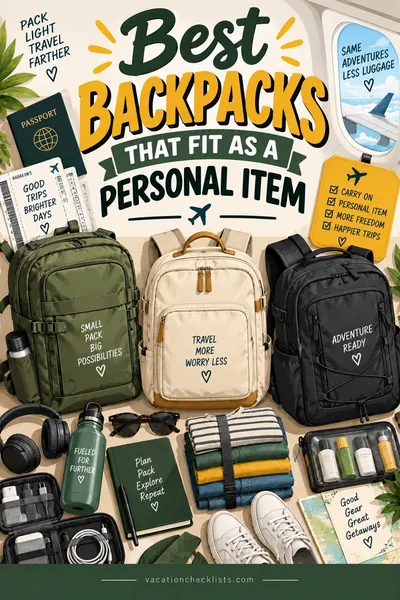
Sizes vary more than people expect. American publishes 18 x 14 x 8 in, United publishes 17 x 10 x 9 in, and a laptop tote that clears American can fail United on width. Southwest, Delta, and Alaska publish no measurement at all: their rule is only that it fits under the seat. Any site quoting an exact personal item size for those airlines made the number up. Our personal item size guide walks through what actually fits under a seat, and if you are going backpack-first, the best personal item backpacks roundup covers the shapes that work.
Step Five: Pack It in the Right Order
- Shoes first, along the spine of the bag, soles facing out, stuffed with socks and chargers. Dead space inside a shoe is wasted volume.
- Roll or cube your clothes. Cubes do not create space by themselves, they create shape, which stops the pile from collapsing into gaps. Our guide on how to use packing cubes covers the technique.
- Heavy items near the wheels. A bag rolls better and stands up when the weight is low.
- Quart bag and electronics on top or in an outer pocket, so security never means unpacking.
- Wear the bulk. Boots, jacket, and heaviest sweater go on your body. This is worth several pounds on a weight-limited airline and costs you nothing.
- Leave the dress-up outfit flat on top, so it comes out with the fewest creases.
A Worked Example: 12 Days in Europe, One Bag
Real itinerary: 12 days, three cities, two intra-Europe flights on a 10 kg airline, mixed September weather.
Packed: 5 tops (2 merino tees, 2 short-sleeve shirts, 1 long-sleeve), 2 bottoms (dark pants, one pair of shorts), 1 fleece, 1 packable rain shell, 1 dress-up shirt, 5 sets of underwear and merino socks, 1 set of sleepwear, swimwear, and 2 pairs of shoes.
Worn on the plane: sneakers, pants, a merino tee, the fleece, and the rain shell. That is roughly 4 pounds off the bag before it is ever weighed.
Laundry: one sink wash on night 4 (underwear, socks, two tees), one laundromat visit on day 8 that washes everything.
Liquids: shampoo bar, bar soap, toothpaste tablets, stick deodorant, and a quart bag holding sunscreen, a small moisturizer, contact solution, and medication. Half the quart bag stays empty, which is the room you need for anything you buy along the way.
Result: a 40-liter soft-sided bag at about 8 kg loaded, comfortably inside a 10 kg limit and under a 55 x 40 x 23 cm box. The same pile would have covered 20 days with one more laundromat visit.
Compare that to the checked-bag version of the same trip: a 23 kg suitcase, an extra 40 minutes at each airport, roughly 18 items of clothing that get worn once, and a staircase problem in every train station.
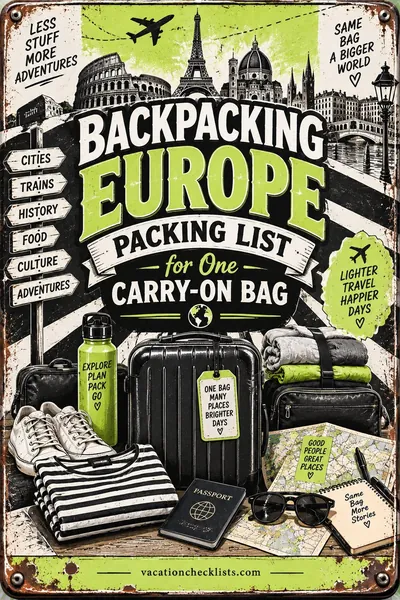
For the item-level list, our carry-on packing list is the companion checklist to this method, and what not to pack in checked luggage explains which items have to ride in the cabin regardless of how you travel.
What to Do If You Get Stopped at the Gate
It happens, usually on a full flight or at a European gate where the airline earns fee revenue.
- Take the pouch out first. Power bank, spare lithium batteries, medication, passport, and laptop must come out before the bag goes below. This is why they live in the personal item.
- Ask if it is gate-check or valet. Valet-checked bags are returned at the jet bridge on arrival, which is much better than the carousel.
- Expect the gate rate to be higher than the online rate for a checked bag. This is why measuring at home matters.
- Do not argue with the sizer. It is a physical box. Compress the bag, remove a layer and wear it, and try again.
Enforcement is inconsistent by design. On a half-empty domestic flight nobody checks. On a full flight, a low-cost carrier, or a European gate, agents work the line with a sizer. Plan for the strict version and the relaxed version feels like a gift.
Frequently Asked Questions
Can I really do two weeks with only a carry-on?
Yes, and it uses exactly the same clothes as a four-day trip. You pack four to five days of outfits and wash once or twice. The only trips that genuinely defeat carry-on only are ones needing bulky specialized gear, like a ski trip with your own boots or a dive trip with your own equipment.
What is the biggest carry-on I can bring?
It depends entirely on the airline. 22 x 14 x 9 inches works on most large US carriers, but the common European box is 55 x 40 x 23 cm, whose longest side is about 21.7 inches. If you fly internationally at all, buying to the European box makes your bag work everywhere. Check your specific carrier before you fly.
Do wheels and handles count toward the size limit?
Almost always yes. American, Delta, United, Southwest, Frontier, JetBlue, Air Canada, British Airways, Lufthansa, Ryanair, and easyJet all state it in writing, and Frontier includes straps too. Where an airline stays silent, assume it counts anyway, because the sizer is a physical box. Wheels and a handle housing typically add one and a half to two inches of depth.
How do I do laundry while traveling carry-on only?
A sink and a bar of soap handle underwear, socks, and t-shirts in about ten minutes, and merino or synthetic items are dry by morning. For everything else, a laundromat visit once a week is roughly two hours including a coffee. Many hotels and rental apartments have a machine, and it is worth filtering for one when you book the middle of a longer trip.
What can I not bring in a carry-on?
Liquids over 3.4 oz that are not medically necessary, most sharp items, and anything on TSA's prohibited list. Working the other way, power banks, spare lithium batteries, vapes, and e-cigarettes can only travel in the cabin and never in a checked bag, because a battery fire in the hold would go unseen.
Should I get a hard-shell or a soft-sided carry-on?
Soft-sided, for carry-on-only travel specifically. It compresses into a sizer, weighs less empty, and survives being wedged into a full overhead bin or a train rack. Hard shells protect fragile items better and look tidier, but on a 7 kg airline their empty weight alone can eat half your allowance.
Does a backpack count as a carry-on or a personal item?
It depends on its size, not its shape. A 40-liter travel backpack is a carry-on. A 20-liter daypack is a personal item on almost any airline. Some very small backpacks squeak in as personal items on strict carriers, which is the whole design idea behind under-seat travel packs.
How much should my carry-on weigh?
If your airline publishes a limit, stay a kilogram under it, because scales at the counter and in your bathroom disagree. If there is no published limit, use a practical one: you have to lift it into the overhead bin by yourself, over your head, on a plane that may already be boarding late.
Before You Book
Do three things this week. Weigh your empty bag, because that number is the tax you pay on every trip. Measure it including wheels and handles against the airline you actually fly. Then lay out four days of clothing on the bed and see how small the pile really is.
Run your bag through the carry-on size checker to confirm it clears, and the only thing you will miss about checked luggage is nothing at all.