Bringing Food Through Airport Security

Solid food travels in either bag, and TSA sets no quantity limit on it. Anything you could spill, spread, spray, pump, or pour is screened as a liquid instead, which means it either meets the carry-on liquid limit or rides in your checked bag. That one distinction answers most food questions at the checkpoint, and it explains why a block of hard cheese sails through while the tub of dip sitting next to it does not.
Not sure about a specific dish? Our free TSA item checker gives you the carry-on and checked answer in a few seconds.
Updated September 2026. TSA publishes its own item list and updates it without much notice, and the screening officer at the lane has the final say on any item regardless of what any list says. Confirm current rules at tsa.gov before you fly.
A note on numbers. No dollar figures on this page. Airside food, shipping counters, and grocery items are priced differently in every terminal and every country, and none of it is ours to quote. What you get instead is the rule that decides which bag your food goes in, and what happens when an officer disagrees with you.
Bringing Food Through Airport Security: The Solid Versus Spreadable Test
TSA does not maintain a special category called "food." It sorts your sandwich the same way it sorts your shampoo, by asking whether the item behaves like a liquid or a gel. TSA's holiday travel tips page puts the test bluntly and memorably: if you can spill it, spread it, spray it, pump it, or pour it, it is a liquid.
Apply that to a plate of leftovers and the answers fall out immediately.
| Food | Carry-on | Checked | Why |
|---|---|---|---|
| Sandwich, wrap, burrito | Yes | Yes | Solid, TSA sets no quantity limit |
| Hard cheese, sliced cheese | Yes | Yes | Solid |
| Soft cheese, cheese spread, cream cheese | Liquid limit only | Yes | Spreadable |
| Whole fruit and cut fruit | Yes | Yes | Solid, but see the arrival section |
| Roasted turkey, ham, cooked meat | Yes | Yes | Solid |
| Gravy, cranberry sauce, salsa, dip | Liquid limit only | Yes | Pourable |
| Peanut butter, hummus, guacamole | Liquid limit only | Yes | Spreadable |
| Cake, pie, cookies, brownies | Yes, with extra screening | Yes | Solid but dense |
| Soup, stew, chili, broth | Liquid limit only | Yes | Pourable, even in a thermos |
| Yogurt, pudding, gelatin, ice cream | Liquid limit only | Yes | Scoopable |
| Coffee beans, ground coffee, tea | Yes | Yes | Dry |
| Protein powder, flour, spices over 12 oz | Separate bin, may need extra screening | Yes | Powder rule |
| Canned food | Allowed with special instructions; if packed in liquid, likely refused above 3.4 oz | Yes | Food packed in liquid is treated under the liquids rule |
| Chocolate bars, candy, dried fruit, jerky | Yes | Yes | Solid |
| Fresh salad with dressing on the side | Yes, dressing separately | Yes | Split the components |
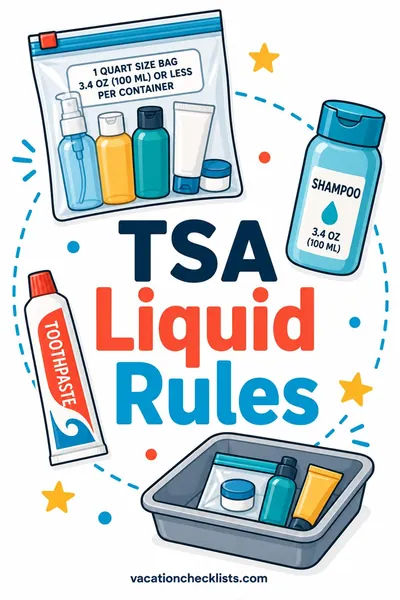
The mechanics of the carry-on liquid limit itself, including the container sizes and the bag, live on our TSA liquid rules page. This page assumes you already know that limit and focuses on which side of the line a given food falls.
Two practical consequences follow from the table.
Split the dish, save the dish. A salad with the dressing poured over it is a liquid problem. The same salad with the dressing left at home is a solid. A bagel with cream cheese already on it gets argued about; a bagel plus a small sealed cream cheese cup that fits the liquid allowance does not.
Freezing does not help for long. A completely frozen item is screened as a solid. Partially melted, slushy, or sweating means it is a liquid again. That works for a short morning hop and fails badly on a connection with a long layover, so treat it as a bonus rather than a plan.
Pies, Cakes, and Why They Get Pulled Aside
Whole pies and cakes are allowed through the checkpoint in carry-on and checked bags, and homemade ones are allowed too. They are also, reliably, the item most likely to get your bag opened.
The reason is physics, not suspicion. A dense, uniform, organic mass is hard for an X-ray to see through clearly, and the image it produces looks like the image a lot of things TSA cares about produce. So the pie gets a second look. In practice that means one of two things:
- A separate trip through the scanner. The officer asks you to take the pie or cake out of your bag and send it through in its own bin, exactly the way a laptop goes through an older lane.
- An explosive trace swab. A sterile cloth is wiped over the outside of the container and fed into a detection machine. It takes well under a minute and nobody touches the food.
Neither one damages the pie. Both take time you have to have budgeted for, which is the real cost. If you are flying with a dessert on a busy holiday morning, add a few minutes on top of your normal buffer and carry it where you can lift it out in one motion.
Where the line actually is with baked goods: filling and frosting that are baked or set inside the item travel with the item. A tub of frosting carried separately is a gel and follows the liquid limit. An ice cream cake, a gelatin mold, and a pie with a loose liquid topping are liquids in a pastry costume, and they belong in a checked bag or at the destination's grocery store.
Homemade Dishes, Casseroles, and Leftovers
Homemade food is not treated differently from store-bought food. There is no rule requiring commercial packaging, no rule against a foil pan, and no rule against a dish your aunt made.
The test is still the texture. A solid casserole, baked and set, is a solid. A casserole swimming in sauce is a liquid in a dish. Mashed potatoes are a gel. Stuffing is a solid. Mac and cheese is usually fine when it has been baked and is firm, and usually a problem when it is loose and creamy.
A few habits make homemade food much less likely to become a scene:
- Bring it cold and firm. Room-temperature and loose reads as liquid to an officer's eye. Chilled and set does not.
- Use a clear container. An officer who can see the contents is far less likely to open it. Opaque foil pans invite a look.
- Tape the lid, do not seal it shut. If a bag search happens, you want the container to open without a fight.
- Keep it on top. The dish should come out of the bag in one motion without excavating the rest of your packing.
- Do not pack it against your liquids bag. If the dish leaks in a bin, you now have two problems.
Ice packs and gel packs used to keep food cold follow the frozen-solid rule like everything else, with the exception of packs cooling baby or medically necessary items. Those carve-outs, along with formula and breast milk, are covered on the TSA liquid rules page and we are not going to restate them here.
Dry Goods, Powders, and the Twelve Ounce Line
Dry food is the easiest category in the whole checkpoint. Coffee beans, tea, pasta, rice, crackers, chips, nuts, cereal, jerky, dried fruit, and candy are solids, and TSA sets no quantity limit on them in either bag.
The one wrinkle is powder. Powder-like substances in a carry-on in quantities over 12 ounces (about 350 mL) should come out of your bag and go through in a separate bin, and they may need additional screening. The stricter wording about oversized powders not being allowed and being disposed of applies to international flights departing for the US. That threshold catches protein powder, ground spices, flour, powdered baby formula in bulk, powdered drink mix, and loose ground coffee in a large sealed bag.
None of that makes powder prohibited. It makes powder slow. If you are carrying a large quantity of anything powdered, put it in checked baggage or keep it in original labeled packaging near the top of your bag so the officer's question has an easy answer.
Snacks Worth Carrying on a Long Flight
The food most travelers actually need through security is not a casserole. It is four hours of something to eat that will not leak, melt, or smell.
Things that hold up well in a bag:
- Nuts, trail mix, and seed mixes
- Jerky, meat sticks, and dried fish snacks
- Protein bars and granola bars
- Hard cheese cut before you leave, wrapped tight
- Crackers, pretzels, rice cakes, and dry cereal
- Apples, oranges, grapes, and firm pears for domestic flights
- Dark chocolate, which survives a cabin better than milk chocolate
- Instant oatmeal or soup packets, filled with hot water after security
- An empty water bottle, filled at a bottle station past the checkpoint
Things that make you unpopular in seat 24B: anything with a strong smell, anything with a sauce, anything that needs cutlery, and anything that will be a puddle by hour three. Our long flight essentials guide covers the rest of the under-seat bag, and the packing list generator puts the snacks in the right compartment for your trip length.
If you have a food allergy, carrying your own safe food is the reliable move. Airline catering changes without warning, buy-on-board menus sell out, and a delay turns a two-hour flight into six. Pack enough to cover a missed connection, not just the scheduled flight.
Special Meals and Allergies Once You Board
Most full-service carriers let you request a special meal in advance on flights where food is served: vegetarian, vegan, gluten-free, kosher, halal, low sodium, diabetic, and child meals are the common set. The request usually has to be in at least 24 to 48 hours before departure, and on many carriers it is attached to the booking rather than to your frequent flyer profile, so it may have to be requested again for every trip and re-confirmed after any schedule change or rebooking.
Two things to understand about allergy handling specifically. First, no airline can promise an allergen-free cabin, because the other passengers bring their own food and the galley is shared. Second, many carriers will make a buffer-zone announcement or hold service of a specific snack if you notify them in advance and again at the gate. Ask at booking, ask at the gate, and ask the crew when you board. Three separate asks, because they are three separate systems.
Carry your own medication in the cabin rather than the hold, in its original labeled packaging. Our airport security tips page covers declaring medical items at the lane so it takes seconds instead of minutes.
The Officer Has the Final Say, Always
This is the part no published list can override, including this one.
A TSA officer can refuse any item at the checkpoint, even an item the agency's own list marks as allowed, if it cannot be cleared on the equipment available or if something about it does not resolve. A footer on every TSA item page says the final decision rests with the TSA officer, and it applies to food exactly as it applies to everything else.
What this means in practice:
- A screenshot of a rules page is not an argument that wins. Officers see them daily.
- The realistic outcome of a disagreement is that you surrender the item or take it back out to the lobby and put it in a checked bag, if you still have time to check one.
- A tub of hummus over the liquid limit is not a security threat, it is just a thing that does not go past the lane.
- The cost is the clock. A bag search around a single food container runs several minutes and lands at the worst possible moment.
The practical defense is to make your food boring to screen. Clear container, solid contents, near the top, ready to hand over.
The Arrival Side Is a Completely Different Agency
Clearing security with food only gets it onto the plane. Getting it into a country is a separate question decided by a separate authority, and it is where most confiscations actually happen.
In the United States, agricultural inspection at the border is handled by Customs and Border Protection working with the Department of Agriculture, and the governing principle is short: declare everything. All travelers arriving in the US must declare all meats, fruits, vegetables, plants, seeds, soil, animals, and animal and plant products, in carry-on, in checked bags, and in a vehicle. Our guide to what to declare at US customs covers the rest of the declaration.
The categories most often refused entry:
- Fresh fruit and vegetables. The Department of Agriculture's plant health service says almost all fresh fruits and vegetables are prohibited because of pest and disease risk, and the apple you did not finish on the plane counts. One recent exception: since June 17, 2024, tomatoes and peppers for personal use are allowed from most countries, though not from Canada in passenger baggage.
- Meat and meat products. Restrictions turn on the animal and the country of origin, and they change as disease outbreaks are reported.
- Seeds, soil, and plant cuttings. Restricted or prohibited in nearly every case.
- Dairy and eggs. Country-dependent and frequently restricted.
Commercially packaged, shelf-stable items such as baked goods, candy, roasted coffee, tea, spices, and most packaged snacks are usually fine, but "usually" is doing real work in that sentence.
The rule worth memorizing is about the declaration rather than the food. If you declare an item and it turns out to be prohibited, a non-commercial quantity can generally be abandoned at the port of entry. If you fail to declare it and it is found, the item is taken away and you can face a penalty. Declaring is always the safer choice.
Every other country runs its own version of this, and some are considerably stricter than the US. Check the destination's own agriculture or biosecurity authority before you pack food into a bag that is crossing a border, and check it for every country on the itinerary, including places you only connect through with checked bags. Our international travel checklist has the pre-departure steps that go with it.
Frequently Asked Questions
Can you bring food through airport security in your carry-on?
Yes. TSA sets no quantity limit on solid food in a carry-on. The restriction applies only to food that behaves like a liquid or gel, which includes sauces, dips, spreads, soup, yogurt, and anything packed in liquid. Those follow the carry-on liquid limit or go in a checked bag.
Can I bring a pie or a cake on a plane?
Yes, in carry-on or checked bags, homemade or store-bought. Expect additional screening, usually a separate pass through the scanner or an explosive trace swab of the container. Frosting carried separately is a gel and follows the liquid limit, and ice cream cakes and gelatin molds should be checked.
Is peanut butter allowed through TSA?
Only within the carry-on liquid limit, because it is spreadable. A full-size jar has to go in a checked bag. The same applies to hummus, cream cheese, honey, jam, and any other nut butter, regardless of how solid it looks in the jar.
Can I take homemade food through security?
Yes. There is no rule requiring commercial packaging. The texture test still decides which bag it goes in, so a baked and set casserole is a solid while a saucy one is a liquid. Bring it chilled and firm, in a clear container, packed where you can lift it straight out.
Do snacks have to come out of my bag at the checkpoint?
Usually not, though officers do ask sometimes, and dense items like a whole cake or a large block of cheese are more likely to be pulled for a second look. Powders over 12 ounces in a carry-on also get additional screening and may need to come out.
Can I bring food back into the United States from abroad?
Some of it, and all of it has to be declared. Fresh fruit, vegetables, meat, seeds, soil, and many dairy items are prohibited or restricted. Packaged shelf-stable food is usually allowed. A declared prohibited item in a non-commercial quantity can generally be abandoned at the port of entry, while failing to declare it can bring a penalty.
What happens if TSA says no to my food?
You will be offered the choice to surrender it, return to the lobby to check a bag, or hand it to whoever dropped you off. Surrendered items are disposed of rather than stored, so there is nothing to reclaim afterward.
Can I bring an empty water bottle and fill it after security?
Yes, and it is the single best food-adjacent habit at any airport. Empty bottles go through with no issue, and nearly every US terminal now has bottle filling stations past the checkpoint. A bottle with water still in it gets you pulled aside, so drain it before the lane.
Sort the questionable containers before you pack them. Our TSA item checker settles any specific dish in seconds, the packing list generator builds the rest of the bag around it, and what not to pack in checked luggage covers what should never go in the hold alongside your leftovers.